


 Crypto.
 Σχετικά
 Passport
 Conference call
 send money
 Όρους
Όρους
 Ιδιωτικότητα
 Sierra market
How Many Solar Panels Do You Actually Need? (3kW, 5kW and 8kW Systems Explained)
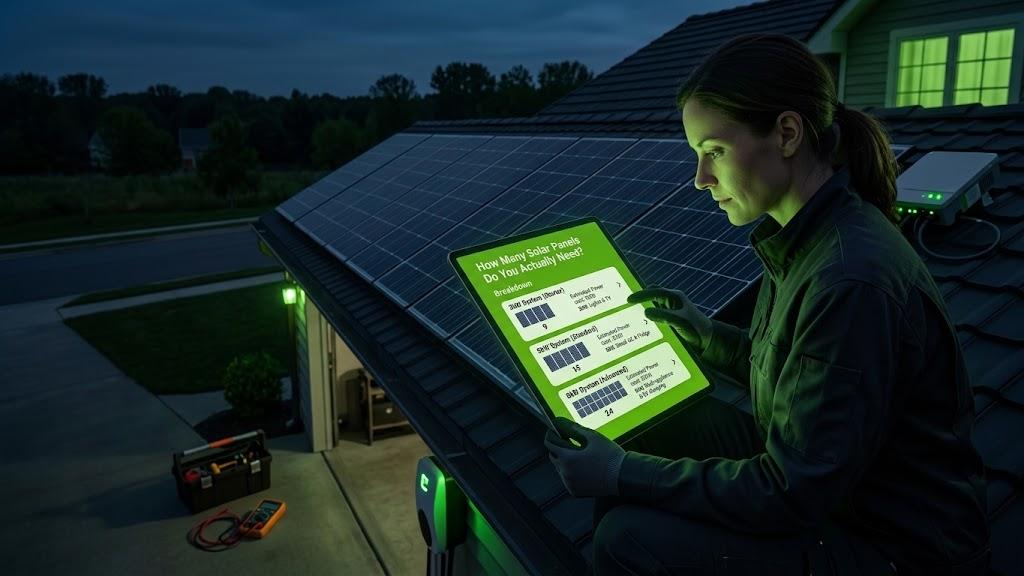
If you're weighing up solar for your home, chances are the very first question on your mind is: how many panels am I actually going to need up there?
It's a fair question, and it's one more people are asking every year. The UK now has over 1.5 million homes with rooftop solar, and 2025 turned out to be a record year for installations, with 269,000 systems going up – a jump of 37% on the year before.
The honest answer is "it depends" – on the size of system you choose, how powerful each panel is, how much usable roof you've got, how much electricity you get through, and how much sun actually falls on your particular roof. A professional Solar Panel Installation Services provider can assess these factors and recommend the right system for your home. But if you want a number to work with right now, here's a rough one: with typical 400W panels, a 3kW system needs about 8 of them, a 5kW system needs around 13, and an 8kW system needs roughly 20.
Let's break down where those numbers come from.
The Quick Maths
The calculation itself isn't complicated:
System size ÷ panel wattage = number of panels
So for a 5kW system built from 400W panels:
5,000W ÷ 400W = 12.5
You obviously can't fit half a panel on your roof, so that gets rounded up to 13 panels - giving you a system that's technically 5.2kW rather than exactly 5kW.
Here's how that plays out across the three most common system sizes:
|
System Size |
With 400W Panels |
Panels Needed |
Roughly How Much Roof |
|
3kW |
3,000 ÷ 400 |
8 panels |
15-18 m² |
|
5kW |
5,000 ÷ 400 |
13 panels |
24-29 m² |
|
8kW |
8,000 ÷ 400 |
20 panels |
37-45 m² |
(Roof area is a ballpark figure - it shifts depending on the actual size of the panels you go with.)
A 3kW System
A 3kW setup tends to suit smaller homes, or households that don't get through a huge amount of electricity.
With standard 400W panels, you're looking at 8 of them, which gives you 3.2kW of total capacity. Swap in 450W panels instead and the sum changes to 3,000 ÷ 450 = 6.67, so you'd only need 7 to get just past 3kW.
It's worth saying that picking a system size shouldn't just come down to "how many panels can I count on the roof." Your yearly electricity use, which way your roof faces, any shading issues, and where your energy needs might be heading all matter just as much.
A 5kW System
Step up to 5kW and you're generally in territory suited to bigger households or homes with heavier electricity demand.
At 400W a panel, that's 5,000 ÷ 400 = 12.5, rounded up to 13 panels for about 5.2kW of capacity. With 450W panels, it's 5,000 ÷ 450 = 11.1, so 12 panels gets you just over the 5kW mark.
This size often makes sense for larger families, or homes that are planning ahead - say, if an EV or a heat pump is on the cards. Both of those can push your electricity use up considerably, so it's worth sizing your system with that future demand in mind rather than just your current bill.
An 8kW System
An 8kW system is a serious setup, and it'll eat up more roof space than the other two.
At 400W per panel: 8,000 ÷ 400 = 20 panels exactly. Go for 450W panels and it drops to 8,000 ÷ 450 = 17.8, so 18 panels does the job.
This tends to suit large homes, properties with high electricity consumption, or small commercial buildings - anywhere that expects demand to keep climbing because of EVs, electric heating, or similar.
The takeaway here: the higher the wattage per panel, the fewer panels you need for the same overall capacity. That's a genuinely useful thing to know if your roof space is tight.
400W vs 450W: Does It Really Make a Difference?
It does, and the comparison table makes it pretty clear:
|
System Size |
400W Panels |
450W Panels |
|
3kW |
8 panels |
7 panels |
|
5kW |
13 panels |
12 panels |
|
8kW |
20 panels |
18 panels |
These are still just planning estimates, though. An installer will land on the exact panel count once they've factored in the actual system design, your roof's real dimensions, and what the inverter needs.
Does a Bigger System Always Mean More Power?
Not necessarily, no - and this trips a lot of people up.
A system's "size" (its kW rating) tells you the maximum it can produce under lab-standard test conditions. It doesn't mean your panels are pumping out that much power every single hour of the day. A 5kW system isn't sitting there generating a flat 5kW from sunrise to sunset - output climbs after sunrise, peaks somewhere in the middle of the day, then tails off as the sun goes down.
Add the seasons into the mix and you'll see a real difference too: winter generation in the UK is typically much lower than summer, simply because there's less daylight and often worse weather.
All of which is really just to say - a proper site assessment tells you far more than the headline kW figure ever will.
How Much Roof Do You Actually Need?
This is often the deciding factor in practice.
As panels get more efficient, you can sometimes fit a bigger system onto the same roof without needing a huge number of extra panels. Roughly speaking, 20 panels for an 8kW system will need somewhere around 37-45 square metres of clear, usable roof.
The word "usable" is doing some work there, though. Chimneys, skylights, vents, dormer windows, and shaded patches all eat into your available space, even on a roof that looks plenty big at first glance. And most roofs have more than one usable section, often facing different directions - a good installer will work out how to make the best use of all of them.
So How Do You Pick the Right Size?
Start with your electricity bills, not your roof.
Look at your actual annual usage in kWh - that number tells you far more about what system size makes sense than the size of your house does. Then think ahead: are you planning to get an electric car, install a heat pump, or add anything else that draws a lot of power? If so, factor that into your sizing now rather than finding yourself short a couple of years down the line.
Timing matters too. Solar only generates while there's daylight, so if you're often home during the day and can run appliances then, you'll get more direct value from what your panels produce. A battery can help bridge that gap by storing daytime generation for use in the evening.
Getting It Installed Properly
Sizing the system is really only step one. How well it performs long-term comes down to correct panel placement, solid electrical work, the right inverter, and sensible overall design.
Berks Insulation installs solar panels across the UK, working with property owners to figure out the right setup for their specific energy needs and their home. If you're comparing installers, don't just look at how many panels are on offer - check the equipment quality, the installer's track record, the warranties on offer, and what support looks like once the panels are up.
Given that 269,000 UK installations happened in 2025 alone - 37% more than the year before - solar is clearly becoming a mainstream part of how homes and businesses here get their power.
Beyond Panel Count: What Else Changes Your Output
The number of panels only tells part of the story. A few other things matter just as much:
-
Which way your roof faces. South-facing is usually the sweet spot in the UK, though east- and west-facing roofs can still perform well.
-
Shading. Trees, neighbouring buildings, even your own chimney can cut into generation - sometimes more than people expect.
-
Panel efficiency. Two panels can be physically identical in size and still produce very different amounts of power.
-
The inverter. This is what turns the panels' output into electricity you can actually use in the house, and its performance matters more than people give it credit for.
A bigger system isn't automatically the smarter choice either - not if the roof can't comfortably hold it, or if you'd end up generating more electricity than you could ever practically use.
Why It's Worth Getting a Professional Opinion
A back-of-envelope calculation is a decent starting point, but it shouldn't be the final word on your system design.
A proper installer will look at your actual electricity use, your roof, its orientation, any shading, and where your energy needs are likely headed - then recommend a system built around all of that, not just a target kW number. Someone might assume they need 20 panels for an 8kW system, only to find the roof can't take that many; switching to higher-output panels can often solve that. Equally, someone with modest electricity use might not benefit from going as big as they first assumed.
The goal, really, is balance: generation, roof space, actual consumption, and budget all pulling in the same direction.
The Short Version
For a rough estimate: a 3kW system needs about 8 panels at 400W each, a 5kW system needs around 13, and an 8kW system needs roughly 20. Switch to 450W panels and those numbers drop to about 7, 12, and 18.
But the "right" number for your home depends on more than just the maths – your electricity use, roof space and orientation, shading, panel choice, and future energy needs all play a part. With the UK solar market growing as fast as it is, getting proper advice from a reputable Solar Installation Company UK before you commit to a system size is worth the time.
Frequently Asked Questions
How many solar panels do I need for a 3kW system? Around 8 panels if you're using 400W panels, or about 7 if you go with 450W ones.
How many solar panels do I need for a 5kW system? Roughly 13 panels at 400W, or around 12 at 450W - it comes down to the exact panel you choose.
How many solar panels do I need for an 8kW system? About 20 panels at 400W, or 18 at 450W. Just make sure your roof can actually fit them before settling on a size.
Is 5kW enough for a typical UK home? For plenty of households, yes - but there's no size that fits everyone. It really comes down to your usage, your roof, and what your energy needs might look like in a few years.
Should I go with 400W or 450W panels? 450W panels mean fewer panels for the same output, which helps if roof space is tight. That said, weigh up efficiency, size, cost, warranty, and expected performance before deciding - it's not just about the wattage number.
Bub
Do?

Κατηγορίες
Διαβάζω περισσότερα
At a FYSee event held in Los Angeles this evening, comedian Hannah Gadsby revealed that Netflix will premiere her upcoming stand-up special titled Douglas—a tribute to her cherished canine companion—sometime in 2020, reaching audiences worldwide. Gadsby expressed her enthusiasm about the announcement: "I'm thrilled to share that Douglas is coming to Netflix next year. While I'm...

Overcoming Netflix Geo-Restrictions Netflix's content library varies significantly depending on your geographical location due to licensing agreements. This means titles such as Les Grands or the 2016 horror film Grave are only accessible within France. When traveling abroad, you might notice that many shows are unavailable or only come with subtitles, limiting your viewing options. Luckily,...
The Nd:YAG Solid-State Lasers Market size was estimated at USD 1.2 billion in 2024 and is projected to reach USD 2.5 billion by 2034, growing at a CAGR of 7.5% from 2024 to 2034. The latest report, titled ‘Global Nd:YAG Solid-State Lasers Market,’ comprises a profound analysis of the fundamental parameters contributing to the global Nd:YAG Solid-State Lasers market...

Attachments in ARC Raiders are a core part of customizing your weapons, letting players tweak guns for specific roles, ranges, or squad needs without changing the entire loadout. You can find them in loot crates, from vendors, or craft them in workshops, and most guns have four attachment slots: Muzzle/Barrel, Underbarrel, Magazine, and Stock. The right combination can make a huge difference in...

During the turbulent 1970s, amidst widespread political unrest and national concern, a charismatic preacher known as Jim Jones emerged as a prominent figure. Claiming to be a miracle worker, he established the Peoples Temple, initially based in San Francisco. He presented it as a welcoming, progressive community dedicated to racial equality, Christian values, and socialist principles....
