


 Crypto.
 Über
Über
 Passport
 Conference call
 send money
 Bedingungen
 Datenschutz
 Sierra market
How AI App Development Companies Help Enterprises Scale Innovation
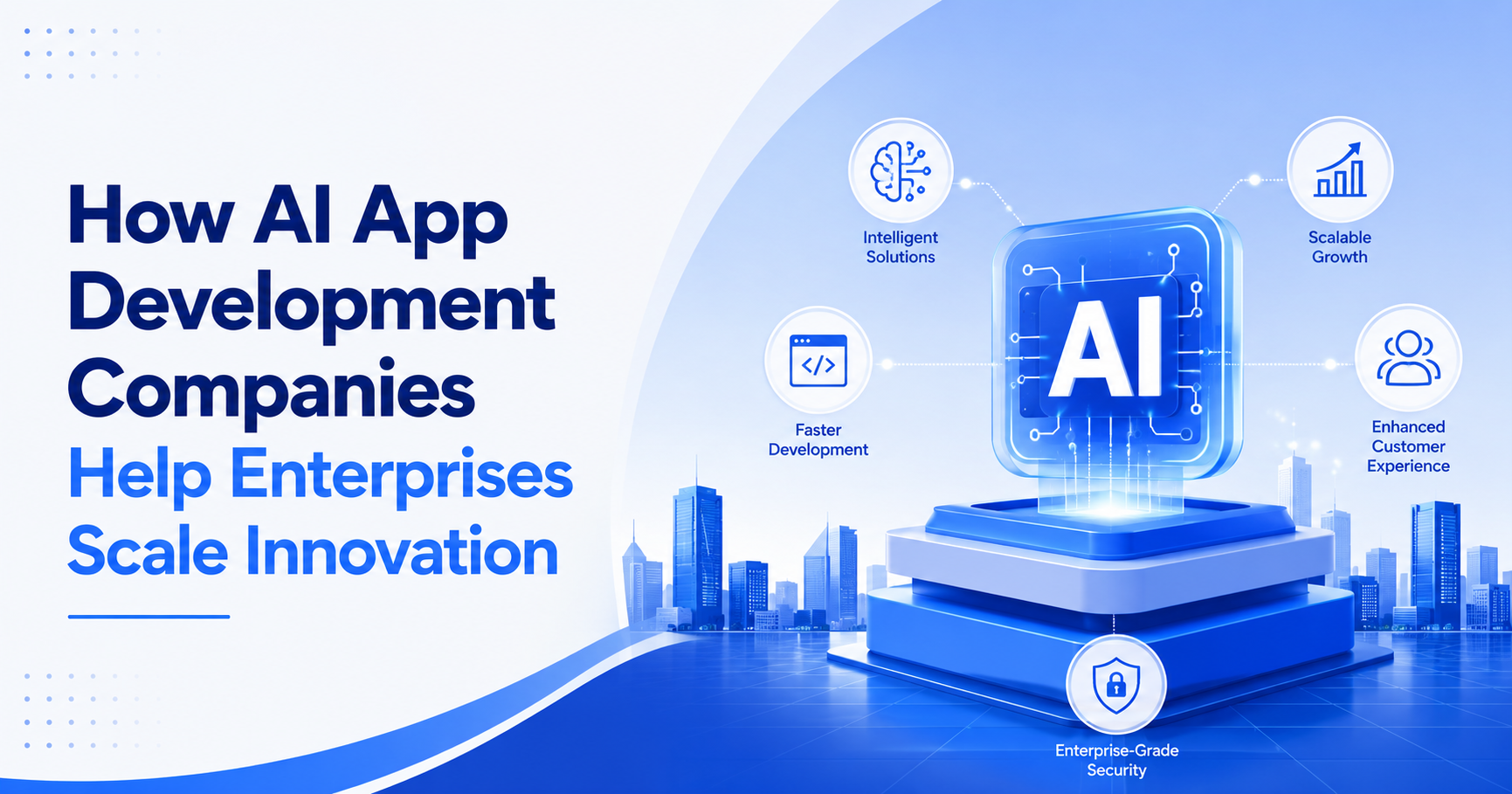
Almost every large company has at least one AI pilot sitting somewhere, proudly demoed to leadership, praised in an all-hands meeting, and then never rolled out beyond the one team that built it. The pilot worked. The enthusiasm was real. And yet a year later, ninety-five percent of the organization is still doing things the old way, because nobody figured out how to take a promising experiment and turn it into something that works reliably across dozens of teams, thousands of users, and an unpredictable range of real-world conditions. This is the actual bottleneck holding back enterprise innovation right now — not a shortage of good ideas, but a shortage of the engineering discipline required to scale them.
Business owners who've watched this pattern repeat across multiple initiatives eventually start asking the right question: not "can we build something innovative" but "can we build something innovative that survives contact with our entire organization." That question is exactly where experienced development partners earn their value, because scaling is a fundamentally different engineering challenge than building a working prototype.
Why a Working Pilot Is the Easy Part
Building something that impresses a room of executives is, relatively speaking, the simplest stage of enterprise AI innovation. A small, motivated team with clean test data and a controlled environment can produce something genuinely impressive in a matter of weeks. The hard part starts immediately after, when that same system needs to handle messy real-world data from across the organization, integrate with a dozen legacy systems nobody fully documented, and perform reliably for users in conditions the original pilot never anticipated.
This gap between pilot and production is where the vast majority of enterprise AI initiatives quietly die. Teams that built the pilot often move on to the next exciting project rather than grinding through the unglamorous work of hardening the system for enterprise-wide use, and without dedicated ownership of that scaling work, the project simply stalls in limbo — too promising to kill, too unfinished to roll out broadly.
- Pilot environments rarely reflect the messy diversity of real enterprise data
- Original pilot teams often lack bandwidth or mandate to handle full-scale hardening
- Integration with legacy systems introduces complexity invisible during initial testing
- Lack of dedicated ownership leaves promising pilots stuck indefinitely in limbo
Recognizing this pattern early lets business owners budget and staff for the scaling phase deliberately, rather than being surprised when a celebrated pilot quietly stalls six months later.
What a Genuine Scaling Partner Actually Brings to the Table
Closing the gap between pilot and enterprise-wide deployment requires expertise that's genuinely different from what built the original prototype, and this is precisely where a capable AI application development company earns its keep. These partners bring experience specifically in productionizing AI systems — handling the unglamorous realities of monitoring model performance across diverse user populations, managing infrastructure costs that scale unpredictably with usage, and building governance structures that let multiple departments adopt and customize a system without each one needing to start from scratch.
What separates a strong scaling partner from a generic development shop is their comfort with the messier, less glamorous half of the work. They're less interested in building one more impressive demo and more focused on the unsexy but essential tasks — error handling for edge cases nobody anticipated, retraining pipelines that keep the system accurate as data evolves, and documentation thorough enough that the system doesn't become unmaintainable the moment its original builders move to another project.
- Deep experience moving AI systems from controlled pilots into messy production environments
- Governance frameworks that let multiple departments adopt a system without duplicating work
- Cost monitoring and infrastructure planning for unpredictable enterprise-scale usage
- Documentation and handover practices that prevent dependency on any single team
Business owners evaluating a potential scaling partner should ask directly about prior experience specifically with this transition, since pilot-building skill and enterprise-scaling skill are genuinely different competencies.
Building the Infrastructure That Makes Scale Sustainable
Beyond finding the right partner, enterprises need to understand what comprehensive support for this transition actually requires, because partial engagements tend to produce systems that scale partway and then hit an invisible ceiling. Full AI application development services at enterprise scale cover far more ground than the original model or feature — they include the data infrastructure needed to feed consistent, reliable information across departments, the monitoring systems needed to catch performance degradation before users notice it, and the retraining pipelines that keep a system sharp as the business itself continues evolving around it.
Enterprises that invest properly in this infrastructure find that scaling additional use cases becomes progressively easier over time, since much of the foundational groundwork — data pipelines, monitoring dashboards, governance processes — gets reused rather than rebuilt for every new initiative. Skipping this investment to save short-term cost tends to produce the opposite effect: every new use case requires reinventing infrastructure that should have been built once and reused repeatedly.
- Centralized data infrastructure that multiple AI initiatives can draw on consistently
- Reusable monitoring and governance frameworks that reduce setup time for new projects
- Retraining pipelines that keep deployed systems accurate as business conditions shift
- Infrastructure investment that compounds value across successive innovation initiatives
This foundational work rarely shows up in a flashy case study, but it's almost always the difference between an enterprise that scales one success into ten and one that keeps starting from zero every time.
Mobile as the Delivery Layer Innovation Actually Needs
All this scaling work matters most when it actually reaches the people meant to use it, and for most enterprises, that means delivering through mobile rather than expecting employees or customers to adopt a new desktop tool. Comprehensive Mobile App Development Services matter enormously at this stage because mobile remains the surface where most real-world adoption actually happens — it's where field employees, frontline staff, and customers interact with new capabilities daily, often without the patience to learn a complex new system that doesn't fit naturally into how they already work.
Enterprises that treat mobile delivery as an afterthought to the underlying AI work often find adoption disappointing even when the technology itself performs well. A brilliant AI capability buried inside a clunky, hard-to-navigate mobile interface gets ignored by busy employees just as readily as a mediocre one would, which makes design and delivery just as critical to scaling success as the underlying model quality.
- Mobile delivery as the primary adoption surface for most enterprise innovation
- Interface simplicity directly determining whether busy employees actually engage
- Consistent mobile experience needed across diverse departments and user roles
- Strong mobile foundations that make future feature rollouts faster and smoother
Investing seriously in this delivery layer is often the difference between an AI capability that gets genuinely used across the enterprise and one that technically works but sits ignored.
Handling the Reality of a Diverse Android Fleet
Enterprises rolling out innovation across thousands of employees or customers on Android face a genuinely harder technical challenge than a single-device pilot ever revealed, because the diversity of devices, OS versions, and hardware capabilities in any large user base is significant. Solid Android App Development Services at enterprise scale require deliberate testing across this diversity, ensuring that an AI-powered feature performing beautifully on a flagship device doesn't quietly fail or lag noticeably on the older, lower-spec devices that a meaningful portion of any large user base is still using.
This matters even more for AI-driven features specifically, since on-device processing demands can vary considerably depending on hardware, and a feature that feels instant on one device might feel sluggish enough on another to undermine user trust in the entire system. Enterprises that skip rigorous device-diversity testing often discover these gaps only after rollout, when the cost of fixing them is considerably higher than catching them during development.
- Rigorous testing across the genuine device diversity present in large user bases
- Careful optimization of AI feature performance for lower-spec, older devices
- Fallback strategies for devices that can't support the full AI feature set smoothly
- Performance monitoring segmented by device type to catch hidden gaps quickly
Enterprises that handle this diversity thoughtfully avoid the frustrating outcome of a feature that scales technically but quietly underperforms for a meaningful slice of their actual user base.
Meeting the Polish Bar That iOS Users Expect
While Android scaling challenges center on diversity, iOS scaling challenges center on a different pressure entirely — meeting a consistently high bar for polish and responsiveness that Apple's user base has come to expect across every app they use. Enterprise-grade iOS App Development Services need to maintain this standard even as an AI feature scales to thousands of users, since iOS users tend to notice and react quickly to any rough edges, whether that's a delayed response from an AI feature or an interface that feels slightly inconsistent with the platform's expected design language.
This matters strategically for enterprises specifically because iOS users frequently represent a disproportionately engaged or valuable segment of an organization's customer or employee base, depending on the use case. Cutting corners here to hit a faster rollout timeline often costs more in damaged trust and disengagement than the time saved was ever worth.
- Consistent polish maintained even as AI features scale across large user populations
- Platform-specific design discipline that meets Apple's typically higher quality bar
- Performance tuning that keeps AI-driven features feeling responsive, not laggy
- Careful attention to the platform's expected interaction patterns and design language
Enterprises that maintain this discipline through the scaling phase, rather than only during the initial pilot, protect the trust and engagement of one of their most valuable user segments.
Turning One Good Pilot Into a Pattern of Sustained Innovation
The enterprises genuinely succeeding at innovation right now aren't the ones with the single most impressive AI pilot — they're the ones who built the infrastructure, partnerships, and delivery discipline needed to take that first success and replicate it across departments, use cases, and platforms repeatedly. Scaling isn't a one-time technical challenge that gets solved and forgotten; it's an ongoing organizational capability that determines whether each new innovation initiative gets easier and faster than the last, or whether every project starts from zero all over again.
The gap between enterprises that scale innovation successfully and those that keep collecting impressive but stalled pilots usually comes down to exactly the kind of deliberate, unglamorous groundwork covered here — the right development partner, genuine infrastructure investment, and disciplined delivery across mobile platforms that actually reach the people meant to use what's been built.
Bub
Do?

Kategorien
Mehr lesen
A high-quality Floor Drain Cover China is essential for modern bathrooms, ensuring effective water management, hygiene, and seamless design. Beyond simply protecting the drainage system, a reliable cover prevents debris accumulation, supports efficient water flow, and enhances safety by reducing slip hazards. Well-crafted products integrate smoothly with flooring materials, contributing to...

After a hiatus since August 2021, China's gaming authority has authorized the release of 45 foreign video games. Among these titles are well-known names like Pokémon Unite, Don't Starve, and Valorant. In addition to international titles, the regulator has also approved 84 games created by Chinese developers. This approval wave marks a significant move in the world's largest gaming...

Wil je weten hoe je een verstopping in je sifon op zonder schade aan je leiding? Dat is best handig, want een verstopte sifon komt vaker voor dan je denkt. Denk bijvoorbeeld aan haren in de badkamer, vetresten in de keuken of gewoon vuil dat zich ophoopt. Zelf je sifon ontstoppen kan écht zonder je leidingen te beschadigen, als je weet hoe het werkt.Met simpele stappen, scherp...

Das Hoyoverse eröffnet in diesem Monat sein erstes Café in Berlin, das den Fans eine einzigartige Gelegenheit bietet, in die Welten von Genshin Impact und Zenless Zone Zero einzutauchen. Das Café befindet sich in der Rochstraße 4 und verspricht ein Erlebnis, das urbanes Leben mit der Fantasie der Spiele verbindet. Im Inneren des Cafés erwarten die Besucher...
Terrific early morning, Refreshing York Giants lovers!In opposition to Significant Blue Check out2 Fresh York Giants' draft alternatives called'great satisfies'Study success: Giants lovers count on substantial components towards Abdul CarterNew York Giants parting techniques with nationwide scoutBig Blue Feeling mailbag: Draft fallout, much more questionsDid Jaxson Dart land within just'tough...
