


 Crypto.
 Sobre
Sobre
 Passport
 Conference call
 send money
 Termos
 Privacidade
 Sierra market
Why Is WhatsApp for Business API Integration a Smart Investment for Growing Companies?
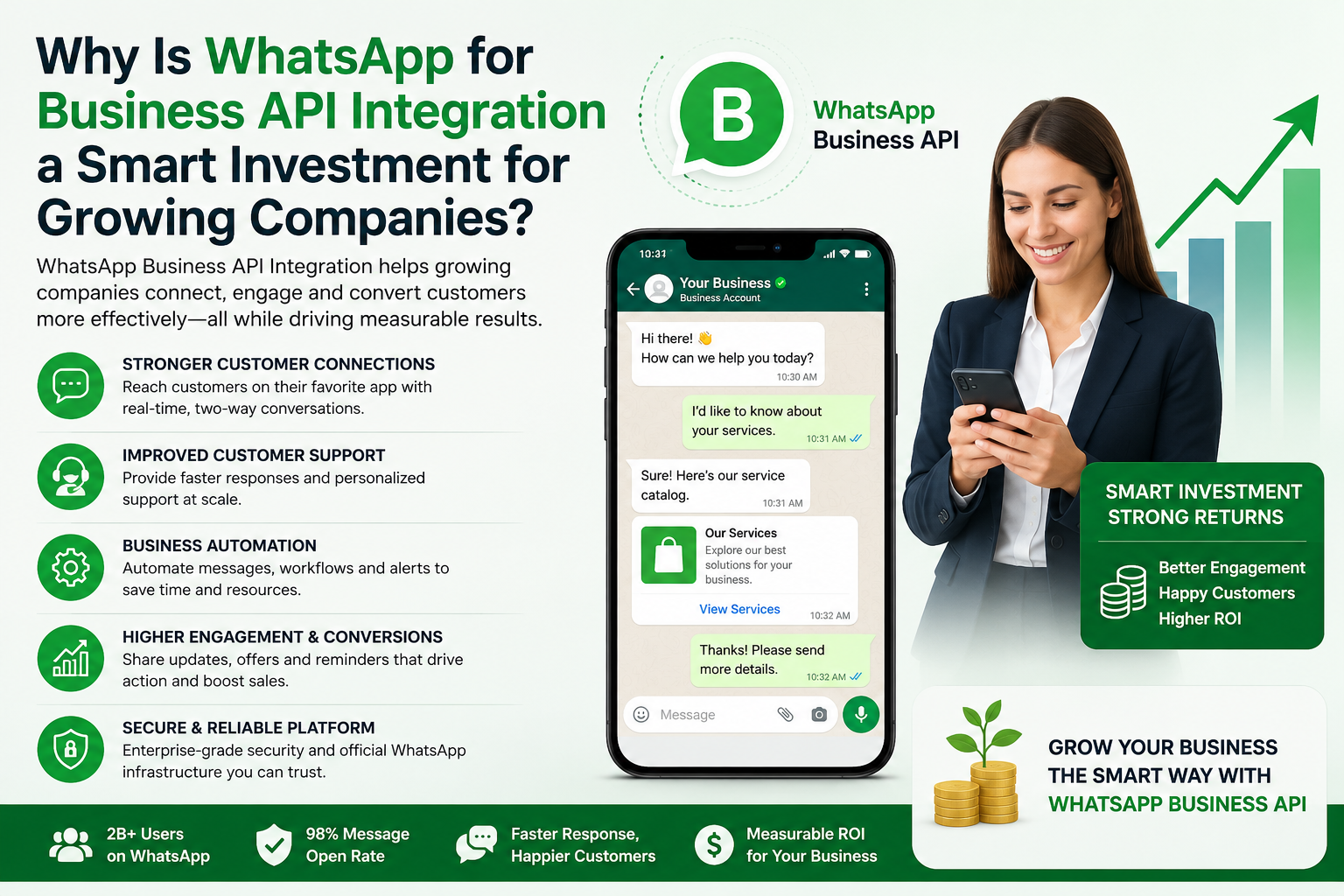
As companies scale, the way they communicate with customers has to scale too. Email open rates keep falling, SMS feels dated, and traditional call centers are expensive to staff. Meanwhile, WhatsApp has quietly become the default messaging app for billions of people across the world. For growing companies looking to modernize customer engagement without blowing up their budget, integrating the WhatsApp for Business API Integration is proving to be one of the smartest moves available today.
This article breaks down why that is, what the API actually offers, and how businesses of different sizes are putting it to work.
Understanding the WhatsApp Business API
Before diving into the benefits, it's worth clarifying what the WhatsApp Business API actually is — because it's often confused with the free WhatsApp Business App.
The WhatsApp Business App is designed for small shops and solo entrepreneurs. It works on a single device, supports basic automation like greeting messages, and is free to use. The WhatsApp Business API, on the other hand, is built for companies that need to communicate at scale. It connects with CRM systems, helpdesk software, marketing platforms, and chatbots, allowing multiple team members or automated systems to send and receive messages simultaneously.
In short, the API turns WhatsApp from a simple messaging app into a full-fledged communication infrastructure for a business.
Meeting Customers Where They Already Are
One of the most compelling reasons to invest in WhatsApp API integration is simple: customers are already there. WhatsApp is used daily by well over two billion people globally, and in many countries it functions as the primary channel for both personal and business communication.
When a company integrates WhatsApp into its customer engagement strategy, it isn't asking customers to download a new app or learn a new interface. It's meeting them inside a tool they already trust and use multiple times a day. This lowers friction dramatically. A customer is far more likely to respond to a WhatsApp message than to open a marketing email buried among dozens of others, or to pick up a call from an unknown number.
For growing companies trying to build engagement quickly without heavy customer education efforts, this existing familiarity is a significant head start.
Higher Engagement Than Traditional Channels
Engagement metrics are where WhatsApp really separates itself from older channels. Open rates for WhatsApp messages are consistently reported to be far higher than email, and response times tend to be much faster than other digital channels. Customers treat WhatsApp messages the way they treat texts from friends and family — checked promptly, rarely ignored.
This matters directly for business outcomes. Order confirmations, delivery updates, appointment reminders, and support replies sent via WhatsApp are seen almost immediately, which reduces missed appointments, cuts down on repeat support inquiries, and improves the overall customer experience. For a growing company, every percentage point of improved engagement translates into fewer wasted resources and more completed transactions.
Scalability Without a Proportional Cost Increase
A major challenge for growing companies is that customer support and engagement needs typically grow faster than the internal team can comfortably handle. Hiring a larger call center team or support staff for every new market or customer segment is expensive and slow.
WhatsApp API integration addresses this through automation and structured workflows. Chatbots can handle frequently asked questions, order tracking, and basic troubleshooting instantly, escalating to human agents only when necessary. This means a lean support team can serve a much larger customer base without a proportional increase in headcount.
Additionally, because the API integrates with existing CRM and helpdesk tools, support agents can see full conversation history and customer context in one place, making each interaction faster and more accurate. This operational efficiency is exactly what growing companies need — the ability to serve more customers well, without ballooning costs.
Rich, Multi-Format Communication
Unlike SMS, which is limited to plain text, WhatsApp supports images, documents, videos, voice notes, location sharing, and interactive buttons. This opens up communication possibilities that plain text simply cannot match.
A retail business can send product catalogs with images directly in a chat. A logistics company can share a live location link for a delivery. A financial services firm can send a PDF statement securely. A healthcare provider can send appointment reminders with a simple "Confirm" or "Reschedule" button, cutting down on no-shows.
This flexibility allows companies to design richer, more useful customer journeys instead of being boxed into short, plain-text updates. For product-based businesses especially, the ability to visually showcase items inside a chat can directly influence purchasing decisions.
Streamlining the Entire Customer Journey
WhatsApp API integration isn't limited to customer support. Growing companies are increasingly using it across the entire customer journey:
Marketing and Lead Generation — Businesses can send personalized promotions, product launches, and offers to opted-in customers, often achieving stronger engagement than email campaigns.
Sales and Conversions — Interactive catalogs and quick-reply buttons let customers browse and inquire about products without leaving the chat, shortening the path from interest to purchase.
Transactional Updates — Order confirmations, shipping notifications, payment receipts, and appointment reminders can all be automated and sent instantly, reducing the volume of "where is my order" inquiries.
Post-Sale Support — Automated FAQs and human agent handoff ensure customers get help quickly, improving satisfaction and retention.
Having all of these touchpoints unified within a single channel — rather than scattered across email, SMS, and phone calls — creates a more coherent and professional brand experience.
Building Trust Through Verified Business Profiles
When a business integrates the WhatsApp API, it can apply for a verified green checkmark badge, confirming to customers that they are communicating with an authentic, legitimate business rather than a random number. This is particularly valuable for growing companies still building brand recognition, as it adds a layer of credibility that can reduce hesitation, especially for first-time customers or in regions where scam messaging is a common concern.
A Cost-Effective Alternative to Legacy Systems
Traditional customer engagement tools — dedicated call center software, bulk SMS gateways, or enterprise email marketing platforms — often come with high licensing costs, per-message fees, and complex setup requirements. WhatsApp API pricing is typically structured around conversation-based fees, and because engagement rates are so much higher, companies often see a better return on every dollar spent compared to channels where a large percentage of messages go unread.
For growing companies watching every line item on their budget, this cost efficiency, paired with higher engagement, makes the return on investment easier to justify than with many legacy alternatives.
Positioning for Long-Term Growth
Perhaps the most important reason WhatsApp API integration is a smart investment is that it positions a company for where customer communication is heading, not where it has been. As messaging apps continue to overtake traditional channels for both personal and business communication, companies that build their infrastructure around this shift now will have a smoother transition than those trying to catch up later.
Integrating early also allows a company to build institutional knowledge — refining chatbot flows, message templates, and support processes — that becomes a durable competitive advantage as the customer base grows.
Conclusion
For growing companies, the WhatsApp Business API offers a rare combination: it meets customers where they already are, drives significantly higher engagement than legacy channels, scales support without ballooning costs, and enables richer, more trustworthy communication throughout the entire customer journey. Combined with its relatively low cost of entry compared to traditional enterprise tools, it's easy to see why so many scaling businesses are treating WhatsApp API integration not as an experiment, but as a core part of their growth infrastructure.
Companies that invest in this integration today are not just solving current communication bottlenecks — they are building a foundation that will continue to pay off as their customer base, and their communication needs, keep expanding.
Bub
Do?

Categorias
Leia mais
To truly master the battlefield in Call of Duty Mobile, diversifying your tactical arsenal is key. Among the powerful Operator Skills available, the Katana offers a thrilling melee-centric playstyle. This skill was introduced during the vibrant Days of Summer event, which expanded the game's content significantly. Unlike standard firearms, it functions as an activated ability, similar to tools...

The MENA Directional Drilling Market is witnessing substantial growth as oil and gas operators in the Middle East and North Africa adopt advanced drilling techniques to enhance hydrocarbon recovery. As Per Market Research Future, directional drilling involves drilling wells at multiple angles rather than vertical, allowing access to difficult reservoirs, reducing environmental footprint, and...

Équipement Sagesse dans Dofus Unity Aux paliers avancés de Dofus Unity, la Sagesse est souvent sous-estimée par les joueurs. Pourtant, elle augmente les capacités de retrait et d'esquive, tout en boostant l'expérience gagnée à la fin des combats. Nombreux sont ceux qui privilégient cette caractéristique pour monter rapidement en...
The Hidden Dangers of Public Wi-Fi: Protecting Your Digital Identity In our increasingly connected world, public Wi-Fi has become an essential part of daily life. We casually connect at train stations, coffee shops, schools, shopping centers, and countless other locations. Our devices often switch automatically to these networks without us even noticing. But this convenience comes with...
Betäubungs-Engine der W-Engine Der wertvolle versteinerte Kern gehört zur W-Engine der Stufe A und wurde speziell zur Verstärkung von Betäubungseffekten entwickelt. Er erhöht die Benommenheitseffekte, besonders bei Gegnern mit hoher Lebenspunktzahl. Ein besonderes Merkmal dieses Kerns ist der Effekt „Behemoth Hunter“, der die Betäubung um bis zu 20 %...
