Crypto.
 Über
Über
 Passport
 Conference call
 send money
 Bedingungen
 Datenschutz
 Sierra market
The On-Demand Data Revolution: An Overview of the Global DaaS Industry
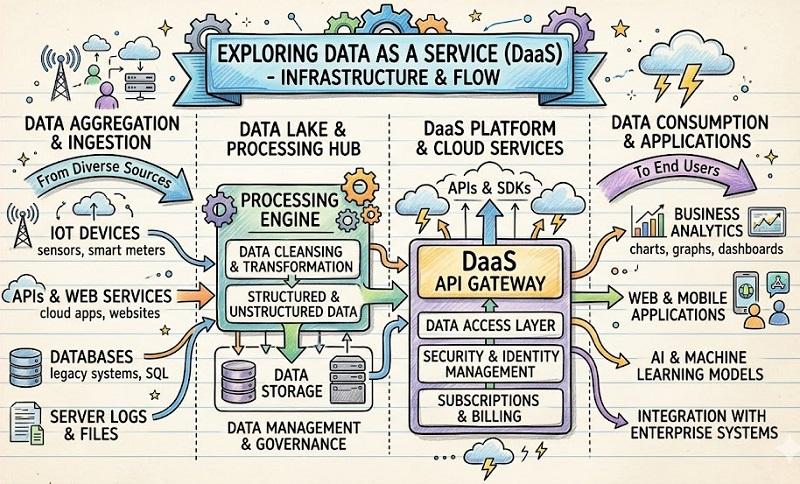
The New Paradigm of Data Consumption
In the modern digital economy, data is the most critical asset for competitive advantage, yet many organizations struggle with data that is incomplete, outdated, or siloed. The global Data as a Service industry has emerged as a revolutionary solution to this problem, fundamentally changing how businesses acquire, consume, and leverage information. Data as a Service (DaaS) is a cloud-based delivery model where data is provided to users on-demand, regardless of their location or the platform they are using. A comprehensive report on the Data as a Service industry highlights its core principle: separating the data itself from the underlying infrastructure required to store and manage it. Instead of businesses having to build complex data pipelines to acquire and process external data, they can now subscribe to a DaaS provider and access clean, curated, and ready-to-use datasets via a simple API call. This transforms data from a capital-intensive asset that must be owned and managed into a flexible, operational utility, much like electricity or water, that can be consumed as needed, dramatically accelerating data-driven innovation.
The Core Components: Providers, Consumers, and Platforms
The DaaS industry is a vibrant ecosystem composed of three primary types of players. At one end are the data providers and aggregators. These are the companies that specialize in collecting, curating, cleansing, and enriching vast amounts of data from a multitude of public and proprietary sources. They are the information brokers of the digital age, with examples ranging from financial data providers like Refinitiv to business information providers like Dun & Bradstreet and consumer data specialists like Acxiom. In the middle are the DaaS platforms, which provide the technological infrastructure for delivering the data. These platforms, often hosted on major public clouds like AWS or Azure, handle the complexities of data storage, management, security, and API delivery. They also increasingly include marketplace functionalities, acting as a "data app store" where multiple data providers can list their products. At the other end are the data consumers—the enterprises, developers, and data scientists who subscribe to these DaaS offerings. They leverage this on-demand data to enrich their own internal datasets, power their applications, train their machine learning models, and make more informed business decisions, without the heavy lifting of data acquisition and preparation.
Key Verticals Driving Industry Growth
The adoption of Data as a Service is a cross-industry phenomenon, but its growth is being particularly supercharged by several key verticals where timely and accurate external data is mission-critical. The Banking, Financial Services, and Insurance (BFSI) sector is a massive consumer. Investment firms and hedge funds subscribe to real-time market data feeds, economic data, and alternative datasets (like satellite imagery or credit card transaction data) to fuel their algorithmic trading and risk models. The Retail and Consumer Packaged Goods (CPG) industry is another major driver, using DaaS to gain a competitive edge. Retailers subscribe to consumer demographic data, location intelligence, and competitor pricing data to optimize their marketing campaigns, select new store locations, and implement dynamic pricing strategies. In Healthcare and Life Sciences, DaaS provides access to anonymized clinical trial data, real-world evidence, and patient demographic data, which is crucial for accelerating drug discovery and personalizing patient care. Other key verticals include Media and Advertising, which relies on audience data for targeted advertising, and Government, which uses demographic and economic data for policy-making and public service delivery.
The Strategic Value Proposition: From Data Silos to Agility
The ultimate value proposition of the DaaS industry lies in its ability to provide businesses with unprecedented agility and to break down the traditional barriers to data-driven decision-making. By offering data as a simple, on-demand service, DaaS eliminates the need for organizations to invest in the costly and complex infrastructure and personnel required to acquire and manage external data sources themselves. This significantly lowers the total cost of ownership (TCO) and democratizes access to valuable information, allowing even small businesses and startups to leverage the same high-quality data as large corporations. Strategically, DaaS allows a company to enrich its own internal data with external context, creating a much more complete and accurate picture. For example, a retailer can combine its own sales data with external demographic and weather data to build more powerful predictive models. This ability to seamlessly blend internal and external data on the fly empowers businesses to react faster to market changes, better understand their customers, and uncover new opportunities, transforming data from a static, siloed asset into a dynamic and strategic enabler of business agility.
Explore More Like This in Our Reports:
Consumer Asset Tracking Market
Bub
Do?

Kategorien
Mehr lesen
The rapid urbanization of developing economies and the need for operational efficiency in developed nations are significantly expanding the Facility Management Services Market Size. Businesses are increasingly transitioning from handling non-core activities in-house to outsourcing them to specialized vendors who can ensure compliance and continuity. This shift allows organizations to focus...

The Market Research on coconut oil indicates strong growth prospects over the coming years as consumer demand for natural, plant based, and multifunctional products continues to increase worldwide. Coconut oil has gained significant popularity across food and beverage, cosmetics, pharmaceuticals, and personal care industries due to its nutritional properties and wide range of applications. The...

Relocating your motorcycle can be one of the most overlooked parts of moving to a new city. While household belongings can be packed and transported through professional movers, your bike requires separate planning. Riding it over a long distance may not be convenient, particularly when you are managing an entire relocation. Professional bike shifting services in delhi provide a...
Introduction About David Beckham David Beckham, a name synonymous with precision and flair on the football pitch, carved out a legendary career primarily from the right side of midfield. Renowned for his exceptional crossing ability, visionary passing, and deadly set-piece delivery, he established himself as one of the finest right-sided midfielders of his generation. His technical mastery and...
The success of the global antibody industry is increasingly dependent on the ability to translate "In-Silico" potential into "In-Vivo" efficacy. A deep Antibodies Market Analysis identifies "Developability Optimization" as the primary operational challenge for 2025. While AI can design thousands of potential antibodies, only a fraction can be manufactured at a scale and purity level suitable...