


 Crypto.
 Environ
 Passport
 Conference call
 send money
 Conditions générale de vente
 Confidentialité
 Sierra market
What standards and certifications are followed in Laminar Airflow System Setup Services?
INTRODUCTION
Laminar Airflow System Setup Services involve the design, installation, testing, and commissioning of controlled airflow systems used in environments where air cleanliness and contamination control are important. These services may be required in pharmaceutical manufacturing, hospitals, operation theatres, IVF laboratories, biotechnology facilities, research laboratories, electronics manufacturing, and other controlled environments. Because laminar airflow systems directly influence air quality and contamination control, their design and installation should follow applicable cleanroom, HVAC, filtration, electrical, safety, and performance-testing requirements.
There is no single universal certification that applies to every laminar airflow project. The standards followed depend on the application, country, room classification, healthcare or industrial requirements, equipment specification, and intended use. A competent project provider should identify the applicable standards at the design stage and document testing and commissioning results before handover.
Why Standards Are Important for Laminar Airflow Systems
Laminar airflow systems are designed to provide controlled, filtered airflow over a defined working or operating area.
Standards help establish requirements for:
- Air cleanliness
- Airflow velocity
- Airflow uniformity
- HEPA filtration
- Pressure relationships
- Particle monitoring
- Equipment safety
- Testing procedures
- Installation quality
- Documentation
- Maintenance
Following recognized standards provides a structured basis for designing, testing, and maintaining the system.
It also helps facility owners compare technical specifications from different suppliers.
ISO 14644 Series for Cleanrooms and Controlled Environments
The ISO 14644 series is one of the most important international references for cleanrooms and associated controlled environments.
Different parts of the series address different aspects of cleanroom performance.
For example:
- ISO 14644-1 addresses classification of air cleanliness by particle concentration.
- ISO 14644-2 addresses monitoring requirements for demonstrating continued cleanroom performance.
- ISO 14644-3 provides test methods for cleanrooms and clean zones.
- Other parts address topics such as design, construction, operation, particle deposition, and equipment used in cleanroom environments.
Where a laminar airflow system forms part of a classified cleanroom or clean zone, the relevant ISO 14644 requirements can provide an important framework for performance verification.
However, an ISO standard should not automatically be interpreted as a certification of the supplier itself. The specific room, system, or facility may be tested and classified according to applicable requirements.
ISO 14644-1 and Air Cleanliness Classification
ISO 14644-1 classifies cleanrooms and clean zones according to airborne particle concentration.
The classification is based on measured particle concentrations at specified particle sizes.
For laminar airflow applications, particle classification can help determine whether the controlled area achieves its specified cleanliness level.
Testing should be performed using appropriate calibrated particle counters and documented procedures.
The required classification depends on the application.
For example, pharmaceutical processing, sterile manufacturing, healthcare environments, research laboratories, and electronics facilities may have different cleanliness requirements.
ISO 14644-2 and Performance Monitoring
Installing a laminar airflow system is only one part of achieving reliable environmental control.
Continued monitoring is also important.
ISO 14644-2 provides a framework for monitoring cleanroom performance.
Monitoring programs may consider:
- Airborne particle concentration
- Pressure differences
- Airflow performance
- Other critical environmental parameters
A monitoring plan should be developed according to the facility's risk assessment and quality system.
This is especially important where the airflow system operates continuously as part of a critical process.
ISO 14644-3 and Testing Methods
ISO 14644-3 provides test methods used to assess cleanroom and clean-zone performance.
Depending on the system and project scope, testing can involve:
- Airflow volume
- Air velocity
- Airflow direction
- Airflow uniformity
- Pressure differential
- Particle concentration
- Recovery characteristics
- Installed filter leakage
Not every test applies to every laminar airflow installation.
The commissioning team should select appropriate tests based on the design specification and intended application.
HEPA Filter Integrity Testing
HEPA filtration is a major component of many laminar airflow systems.
A properly installed filter must be tested for integrity to identify potential leaks in:
- Filter media
- Filter frame
- Gaskets
- Seals
- Housing connections
Installed filter leakage testing is commonly performed using an appropriate aerosol challenge and scanning procedure.
The exact testing method should be selected according to the applicable cleanroom standard, filter specification, and project requirements.
Testing provides evidence that the installed filtration assembly performs as intended.
EN 1822 and HEPA/ULPA Filter Classification
EN 1822 is an important European standard for high-efficiency air filters, including HEPA and ULPA filters.
It addresses filter classification and testing based on particle filtration performance.
Where European specifications or customer requirements apply, EN 1822 may be referenced when selecting and evaluating filters.
Filter selection should consider:
- Efficiency
- Pressure drop
- Airflow requirement
- Filter dimensions
- Housing configuration
- Operating conditions
The filter certificate should correspond to the actual filter supplied.
ISO 29463 for High-Efficiency Filters
ISO 29463 provides international requirements and test methods for high-efficiency filters and filter media used to remove particles from air.
It is closely related to high-efficiency particulate filtration and may be referenced in specifications for HEPA and ULPA filters.
The applicable filter standard should be clearly stated in the project documentation.
Good HVAC Engineering Practices
Laminar airflow systems should not be treated as isolated filtration units.
Their performance depends on the surrounding HVAC infrastructure.
Engineering may involve:
- Air-handling units
- Cooling coils
- Pre-filters
- Fine filters
- HEPA filters
- Ductwork
- Supply plenums
- Return-air systems
- Controls
- Monitoring devices
The HVAC design should provide the required airflow volume, temperature, humidity, filtration, and pressure relationships.
Healthcare and Operation Theatre Applications
Laminar airflow systems are sometimes incorporated into healthcare environments, including specialized operating theatres and controlled clinical areas.
In these applications, the design may need to consider:
- Healthcare facility requirements
- Infection-control principles
- HVAC performance
- Air cleanliness
- Temperature
- Humidity
- Pressure relationships
- Medical electrical requirements
- Fire safety
The exact requirements depend on the type of healthcare facility and the applicable national and local regulations.
For Indian healthcare projects, applicable healthcare engineering guidance and relevant national requirements should be reviewed during project planning rather than relying solely on generic cleanroom standards.
Pharmaceutical Applications
Pharmaceutical facilities often have particularly stringent contamination-control requirements.
Laminar airflow may be used in:
- Sterile manufacturing
- Aseptic processing
- Filling areas
- Dispensing areas
- Sampling areas
- Laboratory environments
Depending on the process, additional requirements may come from:
- GMP frameworks
- WHO guidance
- EU GMP requirements
- National regulatory authorities
- Customer-specific quality standards
For sterile pharmaceutical applications, the airflow system must be evaluated as part of the complete contamination-control strategy.
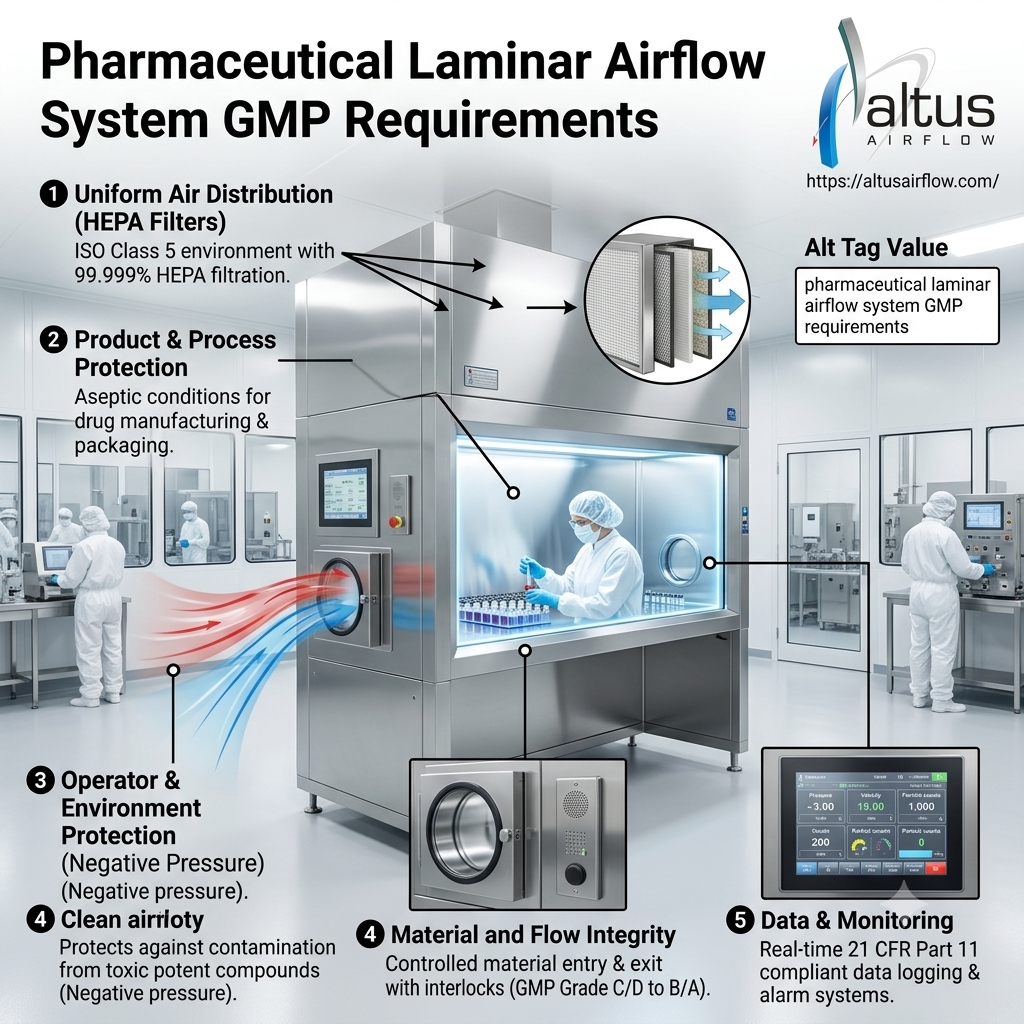
GMP Requirements
Good Manufacturing Practice requirements are particularly important in pharmaceutical and certain healthcare-related manufacturing environments.
GMP focuses on ensuring that products are consistently manufactured and controlled according to appropriate quality standards.
A laminar airflow installation within a GMP facility may therefore need:
- Approved design documentation
- Qualification
- Testing
- Calibration
- Cleaning procedures
- Maintenance procedures
- Change control
- Deviation management
- Periodic review
A laminar airflow supplier should not claim GMP certification simply because an individual system has been installed in a GMP facility. GMP compliance applies to the applicable facility, process, and quality system.
Electrical Safety Standards
Laminar airflow systems contain electrical components such as:
- Blowers
- Motors
- Control panels
- Sensors
- Displays
- Lighting
- Alarms
Electrical design should follow applicable national electrical codes and safety requirements.
In India, project teams may need to consider relevant BIS standards, electrical installation requirements, earthing provisions, and local authority requirements.
The exact requirements depend on the facility and electrical system.
Motor and Fan Selection
Fan and blower performance directly affects laminar airflow.
Engineering should consider:
- Air volume
- Static pressure
- Motor efficiency
- Noise
- Heat generation
- Speed control
- Reliability
- Maintenance
Variable-speed control may be incorporated where appropriate to regulate airflow while maintaining system performance.
Airflow Velocity Testing
Air velocity is an important commissioning parameter for laminar airflow systems.
Testing may be performed at multiple points across the working zone.
The objective is to determine whether the system provides the specified airflow performance and acceptable uniformity.
The acceptance criteria should be defined in the project specification rather than applying an arbitrary velocity to every application.
Different systems can have different design requirements.
Airflow Uniformity
Uniformity is important because localized variations can affect the performance of the controlled zone.
Testing can identify:
- High-velocity areas
- Low-velocity areas
- Turbulence
- Uneven distribution
- Blocked airflow
The results can help engineers adjust:
- Fan speed
- Plenum configuration
- Filter arrangement
- Diffuser design
- Air balancing
Smoke or Airflow Visualization Studies
Airflow visualization can help demonstrate airflow direction and identify undesirable turbulence.
Smoke studies may be used to observe:
- Airflow patterns
- Dead zones
- Reverse flow
- Turbulence
- Potential contamination pathways
This is particularly useful in critical applications where airflow behavior must be demonstrated rather than assumed.
The procedure and acceptance criteria should be defined before testing.
Pressure Differential Testing
Where the laminar airflow system forms part of a cleanroom, pressure relationships between adjacent spaces may be important.
Pressure monitoring can help prevent uncontrolled air movement between areas.
Testing can verify whether the designed pressure relationship is achieved under defined operating conditions.
Temperature and Humidity Testing
Environmental stability may be important for both personnel and sensitive processes.
Commissioning can therefore include verification of:
- Temperature
- Relative humidity
- HVAC response
- Sensor accuracy
The acceptable operating range should be established by the application and facility requirements.
Calibration of Instruments
Testing is only meaningful when measurement instruments are appropriately calibrated.
Instruments can include:
- Anemometers
- Differential-pressure gauges
- Particle counters
- Temperature sensors
- Humidity sensors
- Pressure sensors
Calibration certificates should be maintained as part of the project documentation.
Where a quality-management system applies, calibration intervals and traceability should also be controlled.
Qualification and Validation
Critical laminar airflow systems may require formal qualification.
The qualification process can include:
Design Qualification
Confirms that the proposed design meets defined user and technical requirements.
Installation Qualification
Confirms that equipment and components have been installed according to approved specifications.
Operational Qualification
Demonstrates that the system operates within defined parameters.
Performance Qualification
Demonstrates that the system consistently performs under intended operating conditions.
Not every project requires the same formal qualification structure. The appropriate approach depends on the industry and quality system.
Documentation Requirements
A professional installation should produce appropriate documentation.
This can include:
- Approved drawings
- Technical specifications
- Equipment datasheets
- Filter certificates
- Calibration certificates
- Installation records
- Testing reports
- Commissioning reports
- Qualification documents
- Operation manuals
- Maintenance instructions
- Warranty documentation
Good documentation makes future maintenance and audits easier.
Certifications of the Service Provider
Hospitals and industries should distinguish between product certifications, company certifications, personnel qualifications, and project-specific test reports.
Depending on the organization and scope, useful credentials may include:
- ISO 9001 quality-management certification
- ISO 14001 environmental-management certification
- ISO 45001 occupational health and safety certification
- Relevant product certifications
- Calibrated testing equipment
- Qualified HVAC engineers
- Trained cleanroom technicians
- Industry-specific experience
However, no single certificate automatically proves that a company can successfully execute every laminar airflow project.
Technical experience and documented project performance should also be evaluated.
Why ISO 9001 Can Be Valuable
ISO 9001 relates to quality-management systems.
For a laminar airflow service provider, an ISO 9001-certified quality-management system can indicate that documented processes exist for areas such as:
- Quality control
- Procurement
- Documentation
- Corrective actions
- Customer requirements
- Process management
It does not, by itself, certify that every laminar airflow installation meets a specific cleanroom classification.
Project-Specific Testing Is Essential
One of the most important points for customers is that certifications alone are not enough.
A supplier may have quality certifications, but the installed system still needs to be tested.
Project-specific verification can establish whether the actual installation meets its design requirements.
This can include:
- Air velocity testing
- Airflow visualization
- HEPA integrity testing
- Particle counting
- Pressure testing
- Temperature testing
- Humidity testing
Preventive Maintenance and Requalification
Compliance does not end when the system is commissioned.
Performance can change because of:
- Filter loading
- Fan wear
- Sensor drift
- Duct leakage
- Seal deterioration
- Changes in room configuration
Periodic inspection and testing help maintain performance.
The maintenance program may include:
- Filter inspection
- HEPA integrity testing
- Airflow measurement
- Cleaning
- Motor inspection
- Sensor calibration
- Alarm testing
The frequency should be established according to the system's application, risk assessment, manufacturer recommendations, and applicable quality requirements.
How to Select a Reliable Setup Provider
Organizations should evaluate providers based on:
- Relevant industry experience
- Engineering capabilities
- Understanding of cleanroom standards
- HEPA filtration expertise
- HVAC integration capability
- Testing and commissioning procedures
- Calibration practices
- Documentation quality
- Maintenance support
- Project references
The provider should be able to explain which standards apply to the specific project and why.
Conclusion
Standards and certifications provide an important framework for designing, installing, testing, and maintaining controlled airflow systems. Laminar Airflow System Setup Services may involve references such as the ISO 14644 series for cleanrooms and controlled environments, EN 1822 or ISO 29463 for high-efficiency filtration, applicable HVAC and electrical standards, GMP requirements for pharmaceutical applications, and healthcare-specific requirements where appropriate. The precise standards depend on the intended application and regulatory environment. Equally important are project-specific testing, calibration, qualification, documentation, and preventive maintenance. Organizations should therefore evaluate both the credentials of the service provider and the technical evidence demonstrating that the installed system achieves its specified performance. For organizations requiring professionally engineered airflow and contamination-control solutions, Altus Airflow can provide project-focused planning, installation, testing, and commissioning support based on the applicable technical requirements.
Frequently Asked Questions
1. What standards are commonly followed in Laminar Airflow System Setup Services?
Laminar Airflow System Setup Services may reference ISO 14644 for cleanrooms and controlled environments, EN 1822 or ISO 29463 for high-efficiency filters, applicable HVAC and electrical standards, and industry-specific requirements such as GMP where relevant.
2. Is ISO 14644 mandatory for every laminar airflow system?
Not necessarily. The applicability of ISO 14644 depends on the application and whether the system is part of a classified cleanroom or controlled environment. A provider of Laminar Airflow System Setup Services should identify the applicable requirements during project planning.
3. What is the role of HEPA filter testing?
HEPA filter integrity testing helps identify leaks in the filter media, seals, gaskets, and housing assembly. Proper Laminar Airflow System Setup Services should include appropriate filter testing when required by the project specification.
4. What certifications should a laminar airflow service provider have?
Depending on the project, organizations may look for ISO 9001 quality-management certification, relevant technical qualifications, trained personnel, appropriate testing capabilities, and industry experience. Laminar Airflow System Setup Services should also be supported by project-specific testing and documentation.
5. Are GMP requirements applicable to laminar airflow systems?
GMP requirements can apply when a laminar airflow system is installed in a pharmaceutical or other regulated manufacturing environment. Laminar Airflow System Setup Services for such facilities should be integrated with the site's overall GMP and contamination-control strategy.
Read Our Previous Blog------>How does IVF Labs Design help minimize contamination risks?
Bub
Do?

Catégories
Lire la suite
The expanding bakery and confectionery industries are creating significant opportunities for compound chocolate coating manufacturers. Chocolate coatings provide food producers with a practical way to improve the appearance, flavor, texture, and overall consumer appeal of finished products. Their applications extend across biscuits, cakes, wafers, snack bars, pastries, confectionery products,...

The exponential surge in global data consumption, alongside the pervasive integration of high-bandwidth electronic control units in the automotive and industrial automation sectors, is generating massive commercial momentum throughout the semiconductor sector. As original equipment manufacturers strive to process massive volumes of physical sensor data in real time, commercial demand is driving...

Funcom has released a hotfix for Dune: Awakening that significantly expands the PvE area of the Deep Desert while rebalancing risk and reward between PvE and PvP zones. The change, which went live on June 26, extends the PvE region to cover the entire southern half of the Deep Desert map. Imperial Testing Stations, caves, and similar points of interest in that area are now PvE, allowing players...
The AR & VR in healthcare market is redefining how clinicians train, how patients recover, and how complex medical information is visualized. Augmented reality (AR) overlays digital information onto the real world, while virtual reality (VR) creates fully immersive simulations. The AR & VR in Healthcare Market is growing as hospitals, medical schools, and rehab centers adopt...
A free Pokemon card giveaway at Pokemon Mega Festa 2026 in Seoul was abruptly canceled on May 1 after an estimated 40,000 fans gathered at Seoul Forest, creating safety concerns that forced organizers to halt on-site distribution. The event was part of a month-long celebration tied to the franchise’s 30th anniversary, held in the Seongsu-dong area alongside the Seoul International Garden...
