Crypto.
 Σχετικά
 Passport
 Conference call
 send money
 Όρους
Όρους
 Ιδιωτικότητα
 Sierra market
RGB LED Lighting Control: Why Your Remote Matters More Than Your Strip Lights
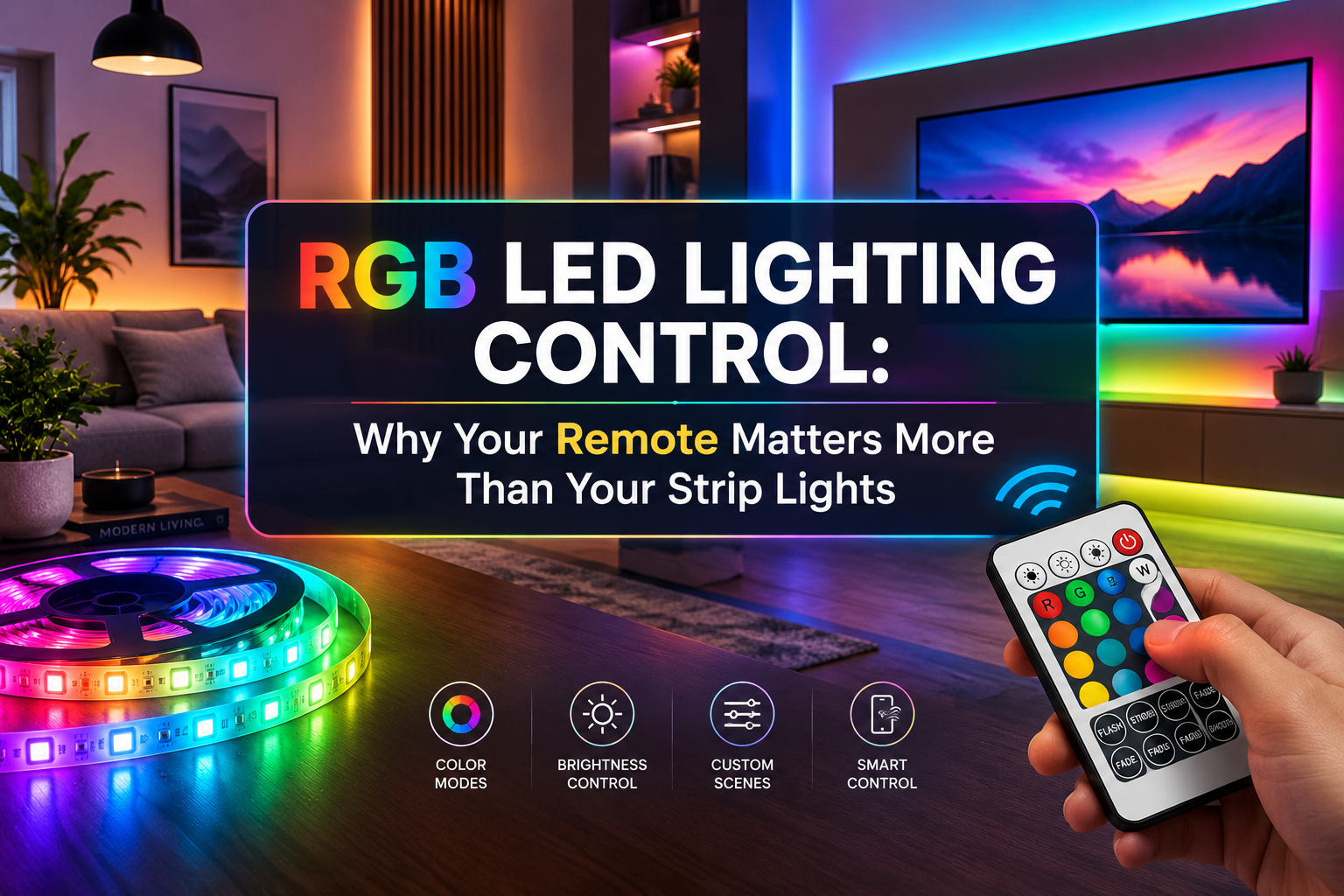
Most people shopping for RGB LED strips spend all their attention on the lights themselves, brightness, color range, strip length, and almost none on how they'll actually control them once installed. That's a mistake, because the controller is what determines whether your lighting setup feels effortless or becomes a daily source of mild frustration. A brilliant strip light paired with a flaky remote is still a frustrating experience every time you walk into the room.
Why the Controller Is the Real Workhorse
An RGB LED strip on its own is just a string of colored diodes. It has no brain. Every color change, dimming adjustment, and lighting effect you see is actually being managed by a separate controller and remote system sitting between the power supply and the strip itself. That means the quality of your control setup directly shapes your day-to-day experience with the lighting, regardless of how good the strip itself is.
The Problem With Basic Infrared Remotes
Most budget LED strip kits ship with a small infrared remote, the kind that requires a direct, unobstructed line of sight to work. Point it slightly off-angle, stand behind a cabinet door, or have furniture in the way, and the signal simply doesn't register. It's a workable solution for a single strip mounted somewhere visible, but it falls apart fast in real installations where lighting is tucked behind crown molding, inside cabinets, or spread across multiple rooms.
Why Line-of-Sight Limitations Matter More Than People Expect
This becomes especially frustrating in kitchens with under-cabinet lighting, media rooms with TV backlighting, or any space where the strip itself is intentionally hidden from view. If the light is meant to be invisible but functional, forcing the remote to have a direct sightline to the receiver defeats half the purpose of hiding the strip in the first place.
What Radio Frequency Control Actually Solves
This is where RF-based controllers, as opposed to infrared ones, change the experience entirely.
How RF Communication Works
Radio frequency controllers use a 2.4GHz signal, the same general frequency band used by many home wireless devices, to communicate between the remote and the receiver. Because RF signals can pass through walls, cabinet doors, and other obstacles, there's no need for the remote and receiver to see each other at all. You can be standing in an adjacent room and still get a reliable response.
Range Advantages in Larger Installations
Beyond ignoring obstacles, RF systems also tend to offer significantly longer working range than infrared. A setup rated for roughly 30 meters of control distance opens up possibilities that infrared simply can't touch, controlling cove lighting across an open-concept living space, coordinating strips across multiple rooms from a single remote, or managing lighting in a commercial space where the receiver might be mounted well out of sight.
What to Look for in a Quality Controller Kit
Not all RGB controllers are built the same, and the differences show up quickly once you're living with the system.
Voltage and Load Compatibility
Different LED strip setups run on different voltages, most commonly 12V or 24V DC, and a good controller kit needs to handle both without forcing you to buy a new unit if you switch strip types later. Load capacity matters just as much. A controller rated for a modest wattage might work fine for a short accent strip, but it will struggle or fail entirely if you're powering a long run of high-density strip lighting.
Independent Channel Control
Genuine RGB control means each color channel, red, green, and blue, is managed independently rather than lumped together. This is what allows for smooth, accurate color mixing rather than a limited set of preset colors that don't quite match what you had in mind.
Touch Interface Versus Button Grids
The physical remote matters more than people expect. A touch-wheel style interface tends to offer more intuitive, precise color selection than a grid of small preset buttons, especially for anyone who wants a specific shade rather than picking the closest match from a fixed palette.
Built-In Dynamic Modes
Static color is only part of the appeal of RGB lighting. Controllers with multiple built-in color-changing effects, along with adjustable speed and brightness for those effects, give you far more flexibility for things like accent lighting during entertaining or subtle ambient movement in a media room.
For anyone assembling or upgrading an RGB lighting setup, it's worth comparing specs like voltage range, control distance, and channel handling side by side before buying. This RF 2.4G wireless RGB LED strip controller kit is a solid reference point for what a properly specced controller and remote pairing should offer, covering the voltage range, load capacity, and wireless performance that separates a reliable setup from a frustrating one.
Where Better Control Makes the Biggest Difference
Cove and Architectural Lighting
Hidden lighting channels built into ceilings or wall recesses are one of the biggest beneficiaries of RF control, since the strips are, by design, out of sight and often out of any possible line-of-sight path for an infrared remote.
Cabinet and Kitchen Lighting
Under-cabinet and inside-cabinet lighting faces the exact same obstruction problem. RF control means the lighting still responds instantly even with cabinet doors closed or countertops blocking the view.
Multi-Room and Commercial Installations
Retail spaces, restaurants, and larger residential installations often need to control lighting across a wider area than a single remote's infrared range could ever reasonably cover. RF-based systems make this kind of coordinated, whole-space control realistic rather than a workaround.
Final Thoughts
The strip light gets all the attention, but the controller is what determines whether your RGB lighting setup actually gets used the way you imagined it. A wireless RF system with solid range, proper voltage compatibility, and independent channel control turns hidden or hard-to-reach lighting from a novelty into something genuinely convenient. Before finalizing any RGB lighting project, it's worth spending as much time evaluating the controller as you do picking out the strip itself.
Bub
Do?

Κατηγορίες
Διαβάζω περισσότερα
As we move through the 2026 youth football season, the emphasis on athlete safety has reached an all-time high. While much of the public conversation focuses on helmet technology, the shoulder pad remains the primary chassis for protecting an athlete’s torso, collarbones, and upper spine. For young players, the risk of injury is often not just about the intensity of the hit, but how the...

Fashion and sportswear have become increasingly intertwined over the past decade. Luxury aesthetics, street culture, and athletic heritage now meet in collaborative collections that reshape how people view everyday style. One partnership that perfectly represents this evolution is the collaboration between Puma and Aimé Leon Dore. This collaboration merges athletic performance roots...
Embark Studios, the developer behind Arc Raiders and The Finals, has detailed the real-time telemetry pipeline that captures every in-game action—down to each bullet fired—within two seconds. Speaking at a Nexon developer conference, data engineer Mattias Andersson explained that the system ingests over 1,000 different event types, peaking at more than 100 billion events per day...

EA SPORTS hat das versprochene Update für FC 26 veröffentlicht. Mit Version 1.5.0 wurden verschiedene Passspielstile im Vergleich zu den Grundattributen reduziert. Obwohl manche Spieler darauf hoffen, dass sich das Gameplay dadurch verbessert, dominiert bei vielen die Zweifel. Nach dem anfänglichen Hype um FC 26 hat sich die Stimmung bei Fans und Content-Erstellern schnell...
Ваза lechuza - это хороший выбор для желающих, кто чтит стиль и многофункциональность в оформлении своего пространства. Такие редкие горшки не только лишь завлекают пристальное внимание своим тонким дизайном, но и обладают обилием удобных особенностей, которые делают их непременными для растений. В официозном web-магазине lechuza.moscow вы можете найти широкий ассортимент кашпо, хороших для...