


 Crypto.
 Environ
 Passport
 Conference call
 send money
 Conditions générale de vente
 Confidentialité
 Sierra market
Why Early-Stage Budgeting Decides Whether a Construction Project Ever Gets Built
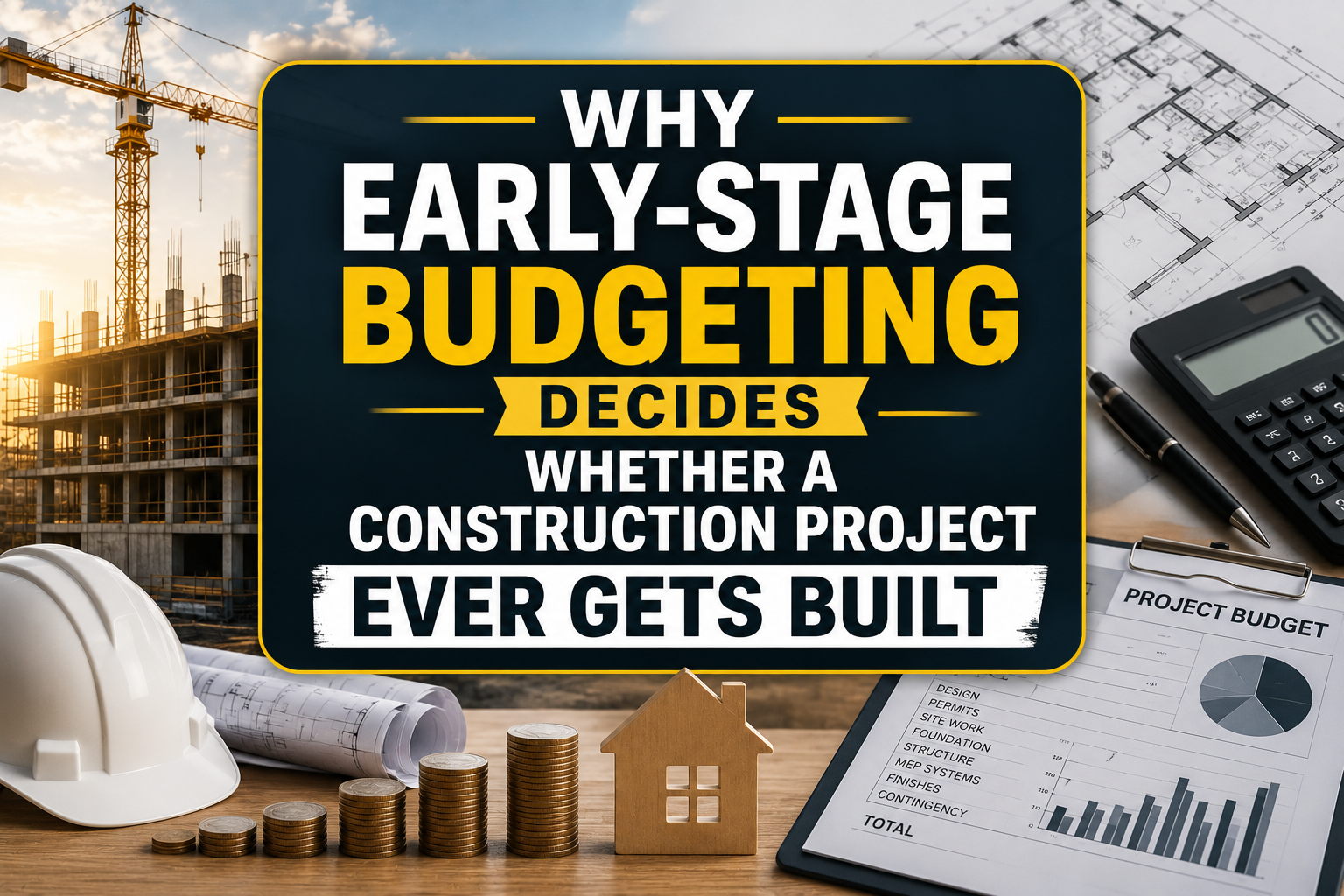
Long before a single permit is filed or a shovel touches dirt, most construction projects face their first real test: does the numbers work at all? This question gets answered, or badly guessed at, during the earliest budgeting conversations, often before drawings even exist. Get this stage wrong, and everything downstream inherits the error. Get it right, and a project moves forward with a realistic sense of what it will actually take to finish.
The High-Stakes Guesswork of Project Kickoff
Early in a project's life, information is scarce by definition. There's usually a concept, a rough idea of scope, maybe a site under consideration, and very little else. Yet this is exactly the moment when critical decisions get made: whether to pursue financing, whether to move forward with design, whether the project is even worth the effort of formal planning.
Why "Ballpark" Numbers Carry Real Weight
It's tempting to treat an early cost figure as a throwaway placeholder, something to refine later once real drawings exist. But that early number often becomes the anchor for everything that follows. Lenders reference it. Stakeholders build expectations around it. Once a number gets repeated enough times in meetings, it starts acting like a commitment even when everyone involved knows it was a rough guess.
The Cost of Getting It Wrong Early
A budget that's too optimistic at the concept stage sets a project up to blow past funding limits later, often after money has already been spent on design and entitlements. A budget that's needlessly conservative can kill a viable project before it gets a fair chance, scaring off investors or owners who assume the numbers simply don't work. Both outcomes trace back to the same root problem: not enough rigor applied at a stage that gets treated as low-stakes.
What Separates a Rough Guess From a Useful Estimate
Not all early-stage numbers are created equal, and understanding the difference matters more than most people realize.
Square-Footage Math Isn't Enough
A simple cost-per-square-foot multiplier feels reassuringly precise, but it flattens out enormous variation. Two buildings of identical size can have wildly different costs depending on site conditions, finish level, structural complexity, and mechanical system requirements. Relying on a single blended rate can mask exactly the kind of cost driver that ends up blowing a budget later.
Layered Metrics for Different Project Types
More reliable preliminary work tends to blend multiple measurement approaches depending on what's actually being built, square footage for buildings, linear footage for utility runs, per-kilometer figures for roadway work, per-hectare figures for irrigation and land development. Using the right metric for the right scope component produces a far more grounded number than forcing everything through the same generic formula.
Accuracy Ranges Change as Design Matures
A useful way to think about early estimating is as a series of narrowing accuracy bands rather than a single fixed number. At the earliest feasibility stage, with no drawings and only a rough concept, accuracy might sit somewhere in the range of plus or minus 50 percent. As massing, site plans, and system preferences take shape, that range tightens. By the time schematic drawings exist, a well-built estimate should be landing much closer to actual costs. Understanding which stage a project is in, and what accuracy range is realistic for that stage, keeps expectations honest instead of falsely precise.
Common Traps in Conceptual-Phase Planning
Scope Creep Before Scope Even Exists
It sounds contradictory, but scope creep often starts before a formal scope is even locked in. Ideas get added in conversation, "what if we also included X," without anyone updating the cost picture to reflect it. By the time a real budget gets built, the concept has quietly grown well past what the original number assumed.
Misreading Market Timing
Material pricing and labor availability shift with market conditions, and a project priced during a stable window can look very different if ground isn't broken for another year. Early planning that ignores likely market movement between now and actual construction start risks locking in assumptions that won't hold.
Underestimating Site-Specific Costs
Two sites that look similar on paper can carry very different hidden costs, poor soil conditions, utility access issues, grading requirements, or permitting complications specific to a jurisdiction. These factors rarely show up in a basic square-footage calculation but can meaningfully shift a project's true cost.
Designing Past the Budget Before Anyone Notices
Design teams naturally want to create something ambitious, and without a running cost check tied to design decisions, it's easy for a concept to drift well beyond what the budget can actually support. By the time this mismatch gets caught, redesign costs money and time that a tighter feedback loop could have avoided.
Why This Stage Deserves Real Expertise, Not Just a Quick Calculation
Because so much rides on getting these early numbers right, and because the available information is genuinely limited, this stage benefits enormously from experienced judgment rather than a plug-and-play calculator. Someone who has seen dozens of similar projects can spot where a concept is likely to run into cost surprises that a generic formula would never flag. For contractors, developers, or owners trying to get a realistic read on a project before committing serious resources to design, working with a team that specializes in this exact phase, through dedicated preliminary estimating services, can be the difference between a budget that holds up and one that quietly falls apart three months into design development.
Turning Early Numbers Into Better Decisions
Feeding Estimates Back Into Design Choices
The real value of a solid preliminary number isn't just knowing a rough total. It's being able to test design decisions against that number in real time, seeing whether a proposed finish level or structural approach fits the budget before it's too late to easily change course.
Using Risk Identification to Strengthen Financing Conversations
Lenders and investors respond better to numbers that come with clearly identified risks and assumptions than to a single flat figure presented with false confidence. A preliminary estimate that spells out what could shift the number, and by how much, builds more credibility than one that pretends certainty it doesn't have.
Final Thoughts
The earliest budgeting conversation in a construction project often gets the least scrutiny and carries the most consequence. Numbers generated at this stage shape financing decisions, design direction, and whether a project moves forward at all. Treating this phase with the same rigor as later, more detailed estimating isn't overkill. It's what keeps ambitious projects grounded in reality instead of discovering the truth the hard way, mid-construction, when it's far more expensive to fix.
Bub
Do?

Catégories
Lire la suite
В мире Arknights: Endfield тактика боя напрямую зависит от управления ресурсами. Глубокий анализ показывает, что скорость накопления ультимейтов — это не случайность, а результат точных расчётов. Каждое использование скилла пополняет общий резервуар энергии отряда, приближая решающий удар. Выбор оружия, такого как двуручный меч, может значительно ускорить этот процесс по сравнению с...

North America Soy Sauce Market Size and Forecast The North America Soy Sauce Market size was valued at USD 9630.91 Million in 2025 and is projected to reach USD 17272.27 Million by 2034, growing at a CAGR of 6.70% during the forecast period (2026-2034). The North America Soy Sauce Market represents a significant segment of the global industry, supported by evolving consumer preferences,...

Brett Haley, renowned for his work on the acclaimed film Hearts Beat Loud, is at the helm of a new project for Netflix titled Sorta Like a Rock Star. Haley’s recent directorial efforts include the musical comedy Hearts Beat Loud, featuring Nick Offerman and Kiersey Clemons, which garnered positive reviews. He is also in the final stages of post-production on All the Bright Places,...
Rare Harry Potter Uncorrected Proof Fetches £6,000 at Auction A highly sought-after uncorrected proof copy of "Harry Potter and the Chamber of Secrets" has been purchased for £6,000 during a weekend auction event. The exceptional item, which came from a residence in West Bridgford, was sold by Arthur Johnson and Sons auction house. Uncorrected proofs are preliminary versions...
DeNA, the developer behind Pokémon TCG Pocket, continues to face challenges in keeping players engaged. Despite promising a significant update months ago, the studio still struggles to find effective solutions for player retention. Attracting new users is not the primary concern—they report a steady influx of newcomers eager to try the game. However, the real issue lies in...
