


 Crypto.
 About
About
 Passport
 Conference call
 send money
 Koşullar
 Gizlilik
 Sierra market
Zero Waste Packaging Market Set for US$917.5 Billion Milestone by 2036
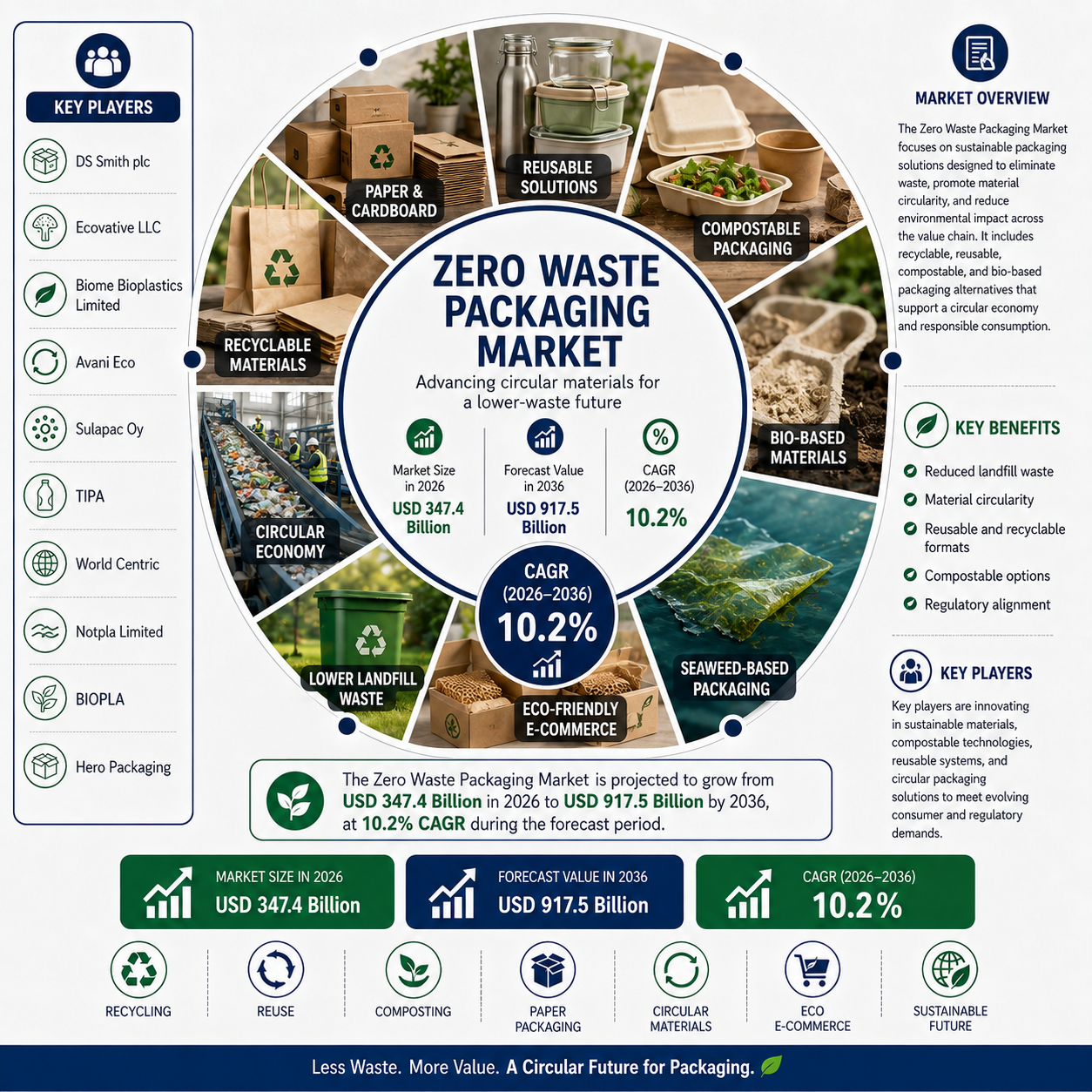
The global Zero Waste Packaging Market is estimated at US$347.4 billion in 2026 and is projected to reach US$917.5 billion by 2036, expanding at a compound annual growth rate of 10.2%, according to Fact.MR. The forecast represents an absolute dollar opportunity of US$570.1 billion between 2026 and 2036.
The Zero Waste Packaging Market is growing as packaging producers and brand owners respond to regulatory restrictions on single-use plastics, extended producer responsibility requirements, sustainability commitments, and changing consumer preferences. The market covers reusable, recyclable, compostable, and biodegradable formats designed to reduce post-consumer packaging sent to landfill or incineration.
Fact.MR valued the global market at approximately US$315.2 billion in 2025 before estimating US$347.4 billion for 2026. The projected increase to US$917.5 billion by 2036 shows how procurement requirements are changing across food and beverages, personal care, e-commerce, healthcare, and other packaging applications.
Extended producer responsibility legislation across Europe, North America, and parts of Asia Pacific is requiring packaging producers to support collection and recycling infrastructure. At the same time, brand owner sustainability pledges are shifting purchasing toward mono-material, compostable, reusable, and recyclable formats.
Zero waste packaging materials include paper, cardboard, bioplastics, mushroom-based composites, seaweed films, glass, metal, and mono-material plastics designed for closed-loop recovery. Their commercial adoption, however, depends not only on material properties but also on collection, sorting, recycling, and composting systems available in individual markets.
Get detailed market forecasts, competitive benchmarking, and pricing trends: https://www.factmr.com/connectus/sample?flag=S&rep_id=12428
Paper and Cardboard Holds 36% Material Share in 2026
Paper and cardboard is expected to account for 36% of the global Zero Waste Packaging Market material segment in 2026, according to Fact.MR. Established procurement patterns, buyer familiarity, application suitability, and pricing accessibility continue to support the segment across major end-use categories.
Reusable and recyclable packaging represents the largest usability type, with a 52% share in 2026. Food and beverages accounts for 42% of the application segment during the same year, making it the leading application category in the market.
One of the report's most specific findings is the scale of the projected value opportunity: US$570.1 billion in absolute dollar opportunity is expected to be created between 2026 and 2036. That figure reflects the substantial procurement shift anticipated across packaging materials and applications during the forecast period.
“The zero waste packaging market is being shaped by two converging forces: regulatory mandates and brand owner commitments,” said Shambhu Nath Jha, Principal Consultant at Fact.MR. “Extended producer responsibility schemes in Europe and parts of Asia are making waste-generating packaging formats economically unviable.”
Shambhu Nath Jha added that public packaging targets are increasing demand for measurable circularity. “The result is a procurement shift that favors paper, mono-material plastics, and compostable substrates. Companies that can deliver scalable, cost-competitive alternatives with proven supply chain compatibility are capturing share from conventional flexible and multi-layer formats.”
India Leads Country-Level Growth at 11.2%
The Asia Pacific region contains the fastest-growth markets identified in the Fact.MR forecast. India is projected to expand at a CAGR of 11.2% through 2036, followed by China at 10.5%.
The United States is forecast to grow at 9.4%, while Germany is projected at 8.8% and the United Kingdom at 7.9%. Brazil is expected to record a CAGR of 6.7%, and Japan is forecast to expand at 6.1%.
India's projected 11.2% CAGR makes it the fastest-growing country included in the provided comparison. Fact.MR attributes demand growth to expanding end-use activity, industrial capacity, infrastructure investment, and increasing adoption across application segments.
Compostable Formats Gain Attention
Compostable packaging is emerging as an important growth area, although it is not currently the largest material category. Food service operators, quick-service restaurants, and direct-to-consumer brands are adopting compostable formats in response to single-use plastic restrictions and corporate waste-reduction targets.
Growth is strongest where municipal composting infrastructure is expanding, particularly in Western Europe and selected North American municipalities, according to the provided market analysis.
The shift also highlights a practical challenge for packaging buyers. The usefulness of compostable packaging depends on whether local waste infrastructure can process it. Fact.MR notes that limited composting and collection infrastructure remains a market constraint, alongside higher material and conversion costs compared with conventional plastics and performance limitations involving moisture barriers and shelf-life protection.
Competitive Activity Focuses on Materials and Market Reach
The competitive landscape includes established packaging companies and specialized material developers. Leading participants identified by Fact.MR include DS Smith plc, Ecovative LLC, Biome Bioplastics Limited, Avani Eco, Sulapac Oy, TIPA, World Centric, Notpla Limited, BIOPLA, and Hero Packaging.
DS Smith plc expanded its product portfolio in 2025 with new models targeting higher-specification applications, according to the supplied industry developments. Ecovative LLC introduced upgraded technology capabilities across core product lines in 2026, while Biome Bioplastics Limited expanded its distribution and service network into high-growth markets in Asia Pacific and Latin America during 2025.
Fact.MR is a market research and competitive intelligence provider that analyzes industry demand, market trends, country-level activity, and business opportunities using secondary research, primary interviews, and forecasting models.
For the Zero Waste Packaging Market, Fact.MR's methodology draws on more than 120 secondary sources, benchmarks more than 65 company product portfolios, covers more than 30 countries, and includes more than 25 primary interviews across manufacturers, distributors, system integrators, and end users.
The research model also cross-checks market demand against shipments, pricing trends, channel mix, product launches, trade-flow checks, sales-pattern reviews, and sensitivity testing.
To View Top Reports
https://social.mytamam.com/blogs/36621/High-Speed-Memory-Signal-Integrity-Test-Market-to-Reach-USD
https://net-pals.com/blogs/29135/Global-High-Speed-Memory-Signal-Integrity-Test-Market-Projected-to
About Fact.MR
Fact.MR provides market research and business intelligence covering global industries and emerging market opportunities. Its research combines demand-side analysis, country-level assessment, primary research, competitive benchmarking, and forecast modelling to support manufacturers, investors, and business decision-makers.
Bub
Do?

Kategoriler
Read More
Former major league infielder and coach has pa sed away after a battle with cancer, according to a report from . He was 74. Cubbage played parts of eight seasons between 1974-81 Brett Sullivan Jersey . A left-handed hitter, he was drafted by the Washington Senators in the second round in 1971. The Senators had also taken Cubbage in the sixth round of the 68 draft, but the Charlottesville native...

The global Glycol Ethers Market is witnessing a period of steady industrial expansion, primarily driven by its indispensable role as a high-performance solvent in the paints, coatings, and cleaning industries. Glycol ethers, characterized by their unique ability to dissolve both water-soluble and oil-soluble substances, are vital components in the formulation of resins, inks, and surface...
2018 MMO Outlook As 2017 wraps up and the momentum for 2018 continues to build, the Massive Overthinking crew has gathered once more to share their daring and playful forecasts for the upcoming year. Reflecting on our previous predictions, which proved to be quite accurate, we’re feeling confident about what’s on the horizon for the MMO landscape. So, what trends and surprises...
90s Sitcom Revival The beloved '90s-inspired sitcom is returning with fresh episodes, bringing nostalgic vibes and unexpected guest appearances to delight fans. Laura Prepon steps behind the camera to direct this latest installment while also reprising her role as Donna. The new season introduces a hilarious premise involving an unexpected kitchen accident that threatens to derail Leia Forman's...
A security vulnerability in Google Chrome 2's V8 JavaScript engine has prompted an emergency update being distributed to users today. Interestingly, Mozilla's security team receives credit for uncovering this flaw, which could enable malicious JavaScript to execute arbitrary code. While Chrome's sandbox provides some protection, clever social engineering could trick users into triggering more...
