


 Crypto.
 About
About
 Passport
 Conference call
 send money
 Termini e Condizioni
 Privacy
 Sierra market
How HVAC Maintenance Supports Better Indoor Air Quality in Commercial Buildings
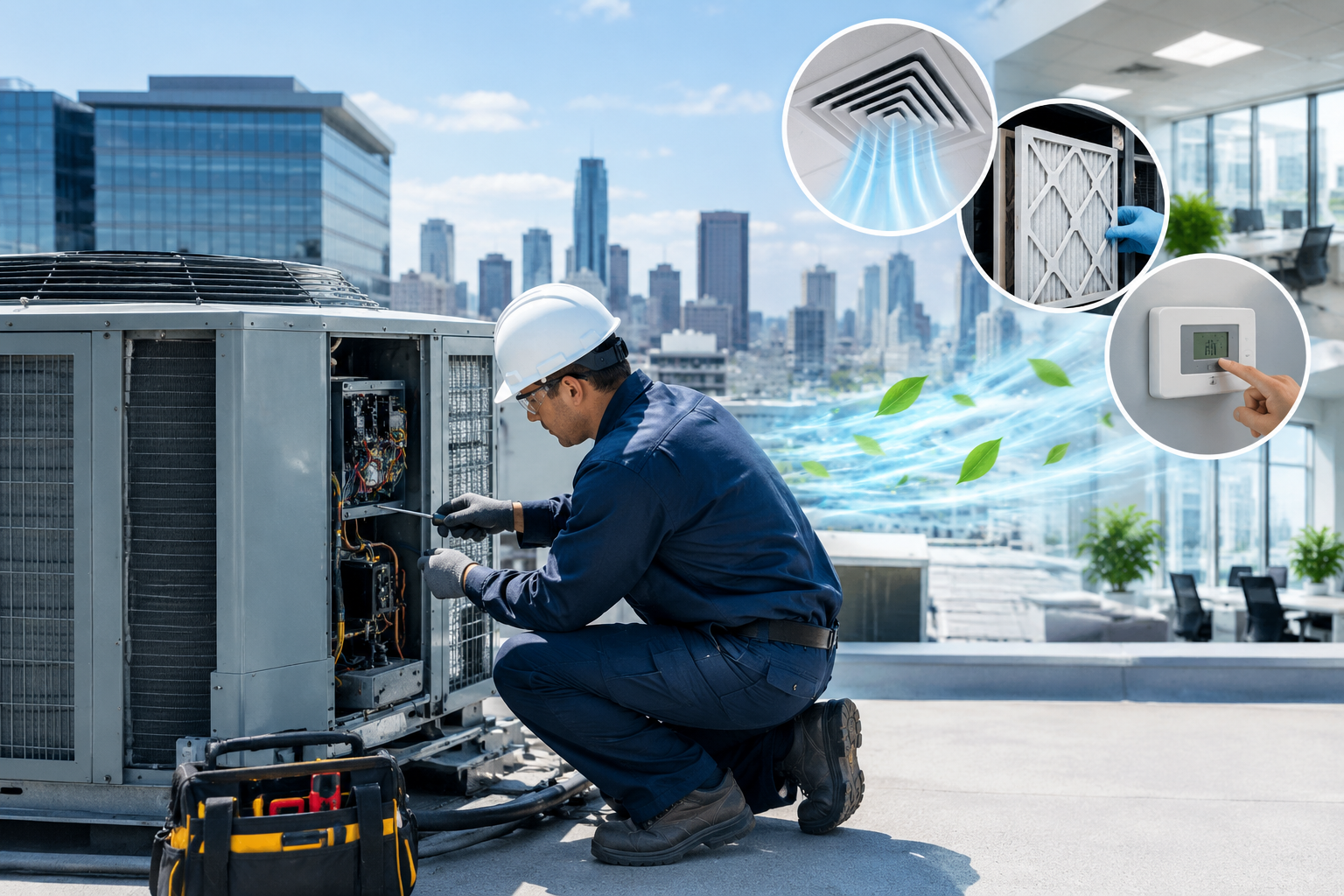
A commercial HVAC system does much more than heat and cool a building. It also plays an important role in moving, filtering, and conditioning indoor air. When the system is properly maintained, it can support a healthier and more comfortable environment for employees, customers, tenants, and visitors.
However, HVAC equipment can gradually lose performance when filters become dirty, coils collect debris, airflow becomes restricted, or mechanical components begin to wear. These issues may affect both system efficiency and indoor air quality.
For commercial property owners and facility managers, regular maintenance is therefore an important part of keeping building systems reliable and indoor environments comfortable.
Why HVAC Maintenance Matters for Indoor Air
Indoor air moves through different parts of a commercial HVAC system every day. Depending on the building, the system may filter incoming air, circulate conditioned air, remove humidity, and bring outdoor air into occupied areas.
When components are not maintained, dust and other particles can accumulate within filters, coils, ductwork, and air-handling equipment. Restricted airflow can also force equipment to work harder to maintain the desired temperature.
Regular inspections help identify these conditions before they become larger problems. Maintenance technicians can examine key components, check system performance, and identify areas that may need cleaning, adjustment, or repair.
The result is not only better equipment performance but also a more consistent approach to managing the building's indoor environment.
Start With the Air Filters
Air filters are among the simplest HVAC components, but they have an important job. They capture airborne particles before air continues through the system.
A filter that becomes heavily loaded with dust can restrict airflow. When this happens, the HVAC equipment may need to operate for longer periods to achieve the desired temperature.
Filter replacement schedules should be based on the building, equipment, filter type, occupancy, and environmental conditions rather than following a one-size-fits-all timetable.
Commercial facilities with high occupancy or activities that generate more dust may require more frequent attention. Facility managers should also monitor filters between scheduled service visits so obvious signs of restriction are not overlooked.
Keep Coils and Mechanical Components Clean
Evaporator and condenser coils transfer heat as part of the cooling process. Dirt and buildup on these surfaces can interfere with heat transfer and reduce system performance.
Other components, including blower assemblies, motors, belts, dampers, and electrical connections, also require periodic inspection.
A professional maintenance visit provides an opportunity to identify worn or dirty components before they contribute to equipment failure. Cleaning and adjustment can help the system operate closer to its intended performance.
This is particularly valuable in commercial buildings where an unexpected HVAC failure can disrupt employees, tenants, customers, and daily operations.
Control Humidity Carefully
Temperature is only one part of indoor comfort. Humidity also has an important relationship with indoor air conditions.
Excessive moisture can contribute to condensation and create conditions that support unwanted biological growth. On the other hand, excessively dry conditions can create discomfort for occupants.
HVAC systems can help manage humidity when they are correctly sized, operated, and maintained. Drain pans and condensate lines should also be inspected because blockages can cause water to accumulate around equipment.
If a facility experiences persistent humidity problems, the issue should be investigated rather than addressed only by changing the thermostat setting.
Check Airflow and Ventilation
Good indoor air quality depends partly on adequate airflow and ventilation. A building may have well-maintained equipment but still experience air-quality concerns if ventilation is insufficient or air distribution is poorly balanced.
During maintenance, technicians can examine airflow, dampers, fans, and other components that influence how air moves through the building.
Changes to a commercial space can also affect ventilation requirements. New partitions, additional occupants, changes in room use, or renovations may alter how air needs to circulate.
For this reason, ventilation should be reconsidered when a building's layout or occupancy changes significantly.
Consider Professional Maintenance Agreements
Managing HVAC maintenance entirely on an as-needed basis can make it difficult to maintain consistency. A problem may receive attention only after equipment performance has already deteriorated.
For property owners looking for Commercial HVAC Maintenance Contracts Nassau County, a scheduled maintenance agreement can provide a more structured approach.
Depending on the facility and equipment, an agreement may include routine inspections, filter checks, cleaning, equipment testing, and recommendations for repairs or improvements.
The exact scope should be based on the building's systems and operational needs. The main benefit is having a planned process instead of relying entirely on emergency service calls.
Watch for Signs of Air Quality Problems
Building occupants often notice changes before facility managers do. Complaints about unusual odors, stuffy rooms, inconsistent temperatures, excessive dust, or uncomfortable humidity should not automatically be dismissed as minor issues.
These symptoms can have several possible causes. HVAC problems are only one possibility, but the mechanical system should be included in the investigation.
Facility managers can document where and when complaints occur. Patterns may reveal whether a problem is limited to one area or affecting the wider building.
Professional testing may also be appropriate when the source of an indoor environmental concern is unclear.
Combine Maintenance With Indoor Air Quality Planning
Maintaining equipment is only one part of managing indoor air conditions. Building owners may also need to consider filtration, ventilation, humidity control, air distribution, and the specific activities taking place inside the facility.
Professional Indoor Air Quality Solutions Staten Island can help property managers take a more complete approach when existing HVAC maintenance alone does not address an indoor environmental concern.
The right solution depends on the building. A warehouse, office, healthcare facility, retail property, and educational building can have very different requirements.
Rather than immediately adding equipment, it is useful to first understand the source of the problem and evaluate how the existing HVAC system is performing.
Keep Detailed Maintenance Records
Good records make HVAC management easier over time. Facility teams should keep track of service dates, filter changes, repairs, equipment issues, inspections, and recommended improvements.
These records can reveal patterns that may otherwise be missed. For example, repeated repairs on the same component could indicate that a larger issue needs attention.
Maintenance records also provide useful information when planning equipment upgrades or replacements. Decisions can then be based on actual system history rather than assumptions.
Take a Preventive Approach
Commercial HVAC maintenance works best when it is treated as an ongoing responsibility rather than an occasional task.
Henick-Lane Service Corp provides commercial HVAC and mechanical services designed to support reliable building operations. A practical maintenance strategy can help property owners identify developing equipment problems, manage system performance, and address indoor environmental concerns before they become more disruptive.
The goal is straightforward: keep HVAC equipment operating properly, maintain appropriate airflow and filtration, monitor humidity and ventilation, and respond to unusual conditions early.
With consistent maintenance and informed planning, commercial property owners can protect their mechanical investment while creating a more comfortable and dependable indoor environment for the people who use the building every day.
Bub
Do?

Categorie
Leggi tutto
The bicycle kick is one of football's most spectacular and iconic moves, and in FIFA 26 Coins, it's just as thrilling. This acrobatic technique allows players to score dramatic goals by striking the ball backward while mid-air. When combined with a powershot, the bicycle kick becomes even more powerful and accurate, making it a high-reward technique that can turn the tide of a match. For...

You live in a cool valley in Utah. You want your house to feel fresh and tidy. You want old junk cleared out of your shed so you can park your truck. But throwing away heavy trash is tough work. Regular curbside cans are way too small for old wood and broken drywall. You feel stuck when a big home remodel piles up waste in your yard. You need a fast way to get rid of unwanted items. Finding the...

When a relationship starts feeling uncertain, it can leave both partners anxious, frustrated, and emotionally drained. You may find yourself wondering whether the bond can be repaired or if you’re simply growing apart. Miscommunication, repeated arguments, lack of intimacy, or even silent resentment can slowly weaken even the strongest connection. If you’re feeling confused about...

Even a year after its surprise drop in 2025, Hollow Knight: Silksong continues to live rent-free in the minds of players everywhere. The long-awaited Metroidvania landed with barely a whisper of warning, yet it instantly dominated conversations\u2014and fan artists\u2019 canvases. Among the lush new kingdoms and treacherous boss fights, one element has sparked a particularly unhinged and...

Der epische Speer „Prospector’s Shovel“ stammt aus der handwerklichen Nod‑End‑Kollektion und ist speziell für Charaktere konzipiert, die auf ATK‑Skalierung und Reaktionen wie „Aufgeladen“ und „Mondladung“ setzen. Der zweite Teil des passiven Effekts gewährt einen zusätzlichen Schadensboost, sobald in der Gruppe „Mondladung“...
