Crypto.
 Über
Über
 Passport
 Conference call
 send money
 Bedingungen
 Datenschutz
 Sierra market
Peptide Therapeutics Market Growth Forecast: USD 444.1 Billion by 2036, India - CAGR 11.6%, China - CAGR 10.9%, USA - CAGR 10.2%
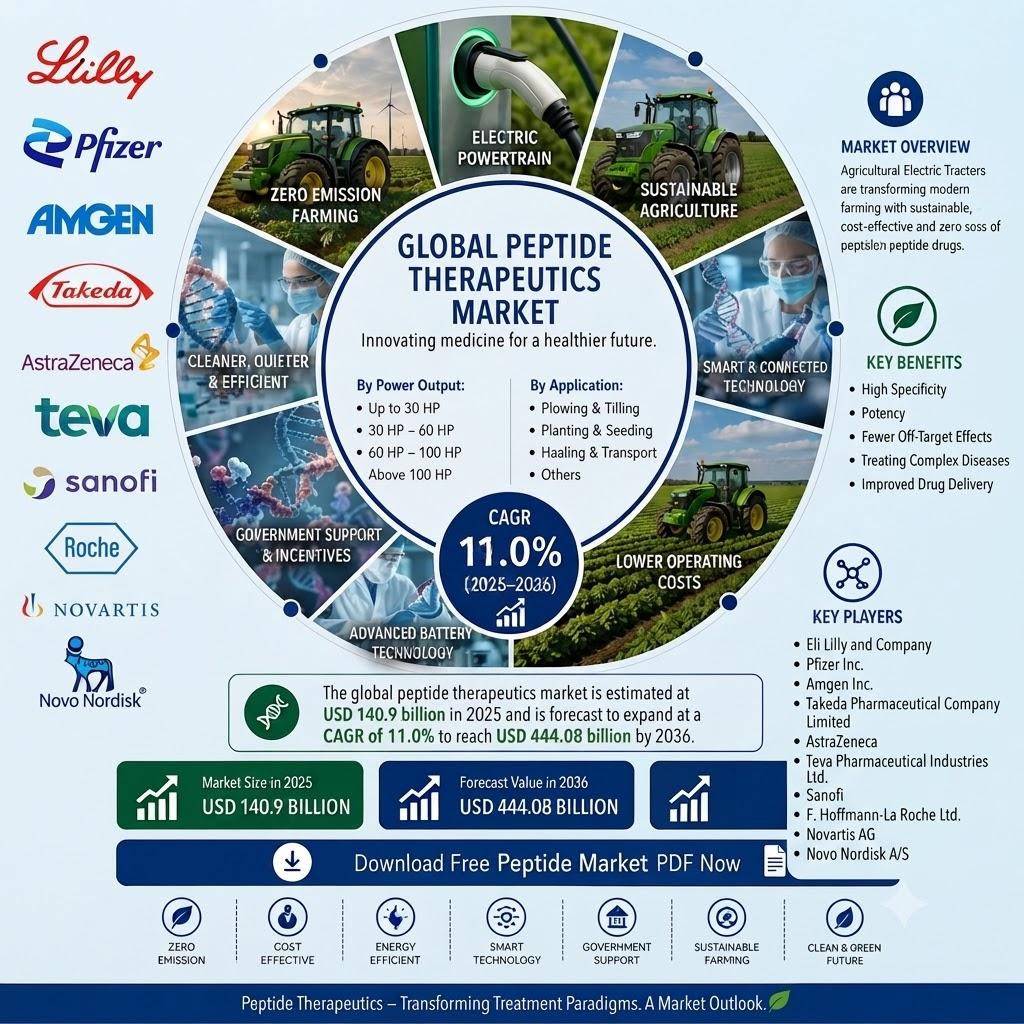
The global peptide therapeutics market is estimated at USD 156.4 billion in 2026 and is projected to reach USD 444.1 billion by 2036, expanding at an 11.0% CAGR during the forecast period. Fact.MR estimates an absolute dollar opportunity of USD 287.7 billion between 2026 and 2036, as the commercial success of peptide-based treatments for metabolic disorders combines with expanding clinical pipelines across oncology, neurology, and cardiovascular care.
Peptide therapeutics encompass drugs derived from amino acid sequences and are used across metabolic, oncological, neurological, cardiovascular, gastrointestinal, and infectious diseases. GLP-1 receptor agonists have become a major source of market expansion, particularly as peptide-based treatments gain wider use for diabetes and obesity management. At the same time, advances in recombinant DNA technology and solid-phase peptide synthesis are improving manufacturing scalability and supporting the development of more complex peptide medicines.
Get detailed market forecasts, competitive benchmarking, and pricing trends: https://www.factmr.com/connectus/sample?flag=S&rep_id=12120
Metabolic disorders lead the application landscape
Metabolic disorders are projected to account for 62% of the application segment in 2026, making them the dominant therapeutic area in the peptide therapeutics market. Strong demand for GLP-1 receptor agonists and insulin analogs used in diabetes management, obesity treatment, and hormonal imbalance disorders supports the segment's leading position.
Cancer, neurological disorders, gastrointestinal conditions, infectious diseases, pain, and cardiovascular disorders represent additional areas of peptide therapeutic development. While metabolic applications currently generate the largest share of market revenue, oncology and neurology are gaining attention as novel peptide candidates and targeted delivery technologies move through clinical development.
Innovative peptide therapeutics are expected to account for 79% of the type segment in 2026. Branded and patent-protected medicines, particularly GLP-1 receptor agonists and novel candidates in late-stage development, continue to command a substantial portion of market value.
Recombinant DNA technology is projected to account for 79% of the synthesis technology segment in 2026. Its role in scalable peptide production makes it increasingly important as pharmaceutical companies respond to high demand and seek greater manufacturing efficiency.
Hospitals are expected to account for 64% of end-use demand in 2026. Established prescribing infrastructure and increasing physician familiarity with peptide-based treatment protocols are supporting adoption across hospital settings.
India, China, and the USA create strong country-level opportunities
India is projected to be the fastest-growing major country market, advancing at an 11.6% CAGR through 2036. Expanding pharmaceutical manufacturing capacity, rising domestic demand for diabetes and metabolic disorder treatments, and increasing investment in hospital infrastructure are supporting peptide therapeutic adoption.
China follows with a projected 10.9% CAGR. Its large patient population affected by metabolic disorders, expanding pharmaceutical manufacturing capabilities, and growing adoption of peptide-based treatment protocols are creating a substantial demand base. The development of biosimilar peptide capabilities is also supporting broader access to selected treatments.
The United States is forecast to expand at a 10.2% CAGR. The country represents one of the largest revenue bases for peptide therapeutics, supported by strong GLP-1 commercialization, advanced clinical research, and established hospital-based prescribing infrastructure.
Japan is projected to grow at an 8.4% CAGR, while Germany is forecast to expand at 7.9%. Saudi Arabia is expected to register a 7.4% CAGR, followed by Brazil at 6.8%. The difference between faster-growing Asian markets and established pharmaceutical markets is shaping investment in manufacturing, distribution, clinical development, and patient access.
Manufacturing capacity becomes a strategic priority
The rapid expansion of peptide therapeutics is increasing pressure on manufacturing capacity. High demand for GLP-1 receptor agonists has highlighted the importance of scalable production systems, while complex peptide structures can require specialized synthesis capabilities and stringent quality controls.
Shambhu Nath Jha, Principal Consultant at Fact.MR, said: “The peptide therapeutics market is being reshaped by the commercial success of GLP-1 receptor agonists in metabolic care, which has created a category with outsized revenue scale. The real strategic question is whether this momentum can be sustained as competition intensifies and biosimilar entry accelerates in older peptide categories.”
Manufacturers with strong recombinant DNA capabilities can benefit from rising demand, particularly where production capacity remains constrained. At the same time, solid-phase peptide synthesis continues to play an important role in producing specific peptide structures and supporting clinical and commercial programs.
Patent expirations and biosimilar competition are expected to introduce another layer of market pressure. Established peptide drugs may face pricing challenges as alternative products enter mature categories, encouraging pharmaceutical companies to differentiate through novel formulations, improved delivery systems, and expanded indications.
Cold-chain storage and distribution requirements also influence market access. Peptide therapeutics can require controlled handling throughout the supply chain, creating additional logistics costs and operational challenges in markets where pharmaceutical distribution infrastructure is still developing.
Oncology and targeted delivery open new growth opportunities
The next phase of peptide therapeutic development is extending beyond metabolic disorders. Peptide-drug conjugates are being explored as targeted delivery platforms in oncology, with the potential to direct therapeutic payloads toward specific tissues while limiting exposure to healthy cells.
Neurology represents another opportunity area. Novel peptide candidates and delivery technologies are being investigated for neurological conditions where conventional drug delivery can present challenges. Cardiovascular applications are also expanding as clinical evidence supports broader use of established peptide-based therapies.
Next-generation oral and combination formulations could further influence market development. Improving patient convenience and reducing dependence on injectable administration may help expand the use of peptide therapeutics across larger patient populations.
Contract manufacturing capacity is also becoming strategically important. Smaller biotechnology companies can rely on specialized manufacturing partners to develop and produce peptide candidates without building complete internal synthesis infrastructure. This creates opportunities for CDMOs with expertise in complex peptide chemistry, scale-up, analytical testing, and commercial manufacturing.
Competitive landscape
The peptide therapeutics market includes global pharmaceutical companies competing through branded portfolios, clinical pipelines, manufacturing capacity, delivery technologies, and commercial infrastructure. Key companies profiled by Fact.MR include Eli Lilly and Company, Novo Nordisk A/S, Sanofi, AstraZeneca, Pfizer Inc., Amgen Inc., Takeda Pharmaceutical Company Limited, Teva Pharmaceutical Industries Ltd., F. Hoffmann-La Roche Ltd., and Novartis AG.
Eli Lilly, Novo Nordisk, Sanofi, and AstraZeneca hold strong positions through established peptide portfolios and advanced clinical pipelines, particularly across metabolic and specialty indications. Pfizer, Amgen, Takeda, Roche, and Novartis participate across oncology, metabolic, and other therapeutic categories.
Competition increasingly centers on manufacturing scale, clinical differentiation, delivery technologies, pipeline depth, and supply reliability. Companies are also investing in next-generation oral formulations, combination products, peptide-drug conjugates, and targeted delivery platforms to expand the commercial potential of peptide medicines.
As demand for high-volume peptide products continues to rise, production capacity is becoming an important competitive differentiator. Pharmaceutical companies with reliable manufacturing networks and access to specialized peptide production capabilities can respond more effectively to demand growth and new product launches.
Market Snapshot
The peptide therapeutics market is valued at USD 156.4 billion in 2026 and is forecast to reach USD 444.1 billion by 2036 at an 11.0% CAGR. Metabolic disorders account for 62% of application demand, while innovative peptide therapeutics represent 79% of the type segment. Recombinant DNA technology leads the synthesis technology segment with a 79% share, and hospitals account for 64% of end-use demand. India leads country-level growth at 11.6%, followed by China at 10.9% and the USA at 10.2%.
To View Top Reports
https://sportgalax.com/read-blog/24622
https://afgbfh.blogspot.com/2026/10/perfume-market-to-be-worth-usd-778.html
https://medium.com/@sanskrutila11/perfume-market-could-reach-usd-77-8-348abeec733f
About Fact.MR
Fact.MR is a market research and consulting company providing market intelligence, competitive analysis, and forecasting across global industries. Its research covers emerging technologies, evolving consumer trends, industrial developments, and changing business environments. Fact.MR delivers data-driven insights designed to support strategic planning, investment decisions, and market-entry initiatives.
Bub
Do?

Kategorien
Mehr lesen
Six ans après son lancement, Genshin Impact n'a toujours pas rejoint le catalogue Nintendo, malgré une promesse officielle de portage formulée en janvier 2020. Le silence prolongé de HoYoverse a progressivement éteint les espoirs des joueurs. Mais une découverte récente dans les fichiers du jeu ravive la flamme. Un gestionnaire de connexion...

Last week’s European box office faced significant challenges due to a combination of extreme heat and the distraction of the World Cup, impacting overall ticket sales across the continent. While some films managed to perform well, others saw notable declines. The superhero sensation “Spider-Man” managed to maintain momentum despite these obstacles. It earned a record-breaking...
Introduction Operational efficiency is essential for the success of any healthcare practice. Clinics and medical offices must manage patient care while handling administrative, communication, and marketing responsibilities. As workloads increase, maintaining efficiency becomes more challenging. This is where a healthcare virtual assistant can make a significant difference by streamlining...

If there’s one thing that drives a Hollow Knight: Silksong player up the wall, it’s a quest that points you in a direction and then immediately clams up. The Huntress’ “Broodfeast” mission is exactly that kind of head-scratcher. You’re told to gather 60 ingredients for her hungry little brood, but the game hands you nothing more than a vague nudge and a pat...
Understanding the difference between cosmetic and reconstructive gynecology is essential for patients seeking intimate health treatments, as both fields serve distinct yet sometimes overlapping purposes. While cosmetic procedures focus on enhancing appearance and boosting confidence, reconstructive procedures aim to restore normal anatomy and function after trauma, childbirth complications, or...