


 Crypto.
 About
About
 Passport
 Conference call
 send money
 Termeni
 Confidențialitate
 Sierra market
Organic Foods Market Set for Decade of High Growth, Reaching USD 797.45 Billion by 2036
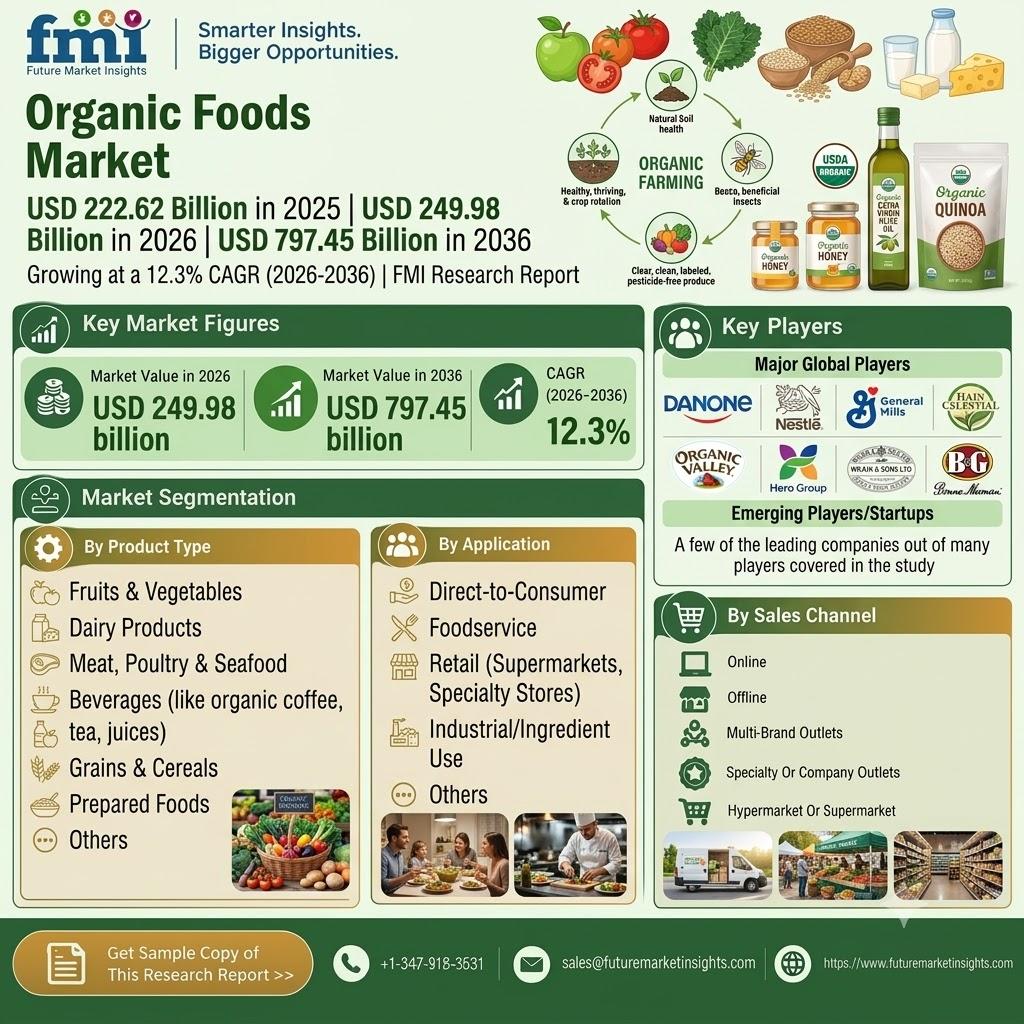
NEWARK, Del., October 13, 2026. — The global Organic Foods Market was valued at USD 222.62 billion in 2025 and is projected to reach USD 249.98 billion in 2026, expanding to USD 797.45 billion by 2036 at a CAGR of 12.3% from 2026 to 2036, according to Future Market Insights (FMI).
The growth outlook is being shaped by rising consumer awareness of pesticide residues, food safety, environmental sustainability and the nutritional attributes associated with organic food products. FMI identifies expanding organic certification infrastructure, improved supply chain traceability and broader retail availability as key growth drivers. Growing distribution through supermarkets, hypermarkets and online grocery platforms is also helping organic foods reach consumers beyond traditional specialty retailers.
Certification integrity and sustainable packaging shape purchasing decisions
Food producers and retailers are placing greater emphasis on certification standards, ingredient transparency, sustainable packaging and supply chain reliability. FMI indicates that fruits and vegetables account for 34.8% of the category segment in 2026, reflecting strong consumer interest in certified fresh produce. Unprocessed organic foods lead with a 52.6% share, while sustainable packaging accounts for 54.2% of the packaging type segment.
Supermarkets and hypermarkets represent 45.9% of the distribution channel segment, highlighting the importance of mainstream retail in organic food sales. Producers are expanding organic product availability across fresh produce, packaged foods and other grocery categories while investing in certification, traceability and environmentally aligned packaging to meet evolving consumer expectations.
👉 Get Detailed Market Forecasts, Competitive Benchmarking & Industry Insights: https://www.futuremarketinsights.com/reports/sample/rep-gb-16722
Where growth is fastest
- South Korea — 13.5% CAGR: Demand is expected to benefit from government support for organic agriculture, high consumer health awareness and expanding organic retail infrastructure. Improved product availability and established consumer interest in food quality are creating opportunities for certified organic food suppliers.
- China — 13.0% CAGR: Growth is supported by increasing food safety concerns, rising middle-class demand for premium food products and investment in organic certification and agricultural modernization. Producers and retailers are expected to expand their organic offerings as consumers seek greater transparency and quality assurance.
- Global markets — 12.3% CAGR: Worldwide expansion is being driven by growing interest in sustainable food production, broader certification availability and increased distribution through mainstream grocery and digital retail channels.
What leads the market
- Fruits and vegetables — 34.8% share in 2026: Fresh produce leads the category segment as consumers prioritize organic certification for foods where pesticide residue concerns and agricultural production practices influence purchasing decisions.
- Unprocessed organic foods — 52.6% share: Unprocessed products hold the leading position as demand continues for organic foods in their natural or minimally processed forms.
- Sustainable packaging — 54.2% share: Packaging choices are becoming increasingly important as consumers expect organic brands to reflect broader environmental values through responsible material selection and packaging practices.
- Supermarkets and hypermarkets — 45.9% share: Mainstream retail remains the leading distribution channel, supported by established grocery infrastructure, dedicated organic sections and convenient access to certified products.
- Online grocery and direct-to-consumer channels: Digital distribution offers additional opportunities for organic food suppliers to reach consumers, communicate certification credentials and broaden access to specialized product portfolios.
The hurdle
Maintaining certification integrity, supply consistency and price competitiveness remains a key challenge. Organic food producers must meet applicable certification requirements while managing agricultural sourcing, production costs, distribution and packaging expenses. Differences in farming practices, certification infrastructure and supply chain capabilities can affect product availability and pricing across markets.
The price premium associated with organic products can also limit adoption among cost-conscious consumers, particularly when conventional alternatives are readily available. Companies must balance affordability with quality assurance, transparent labeling and compliance with relevant organic standards. Suppliers that strengthen producer relationships, improve traceability, optimize distribution and expand production without compromising certification integrity can reinforce their competitive position.
For full coverage of the Organic Foods Market, including forecasts by category, product type, packaging, distribution channel, region and country, visit the FMI Organic Foods Market Report. https://www.futuremarketinsights.com/reports/organic-foods-market
Key market developments and demand trends
The organic foods market is benefiting from broader changes in consumer purchasing behavior, agricultural practices, retail infrastructure and sustainable product development.
- Growing food safety awareness: Rising consumer attention to pesticide residues, production methods and food quality is supporting demand for certified organic products across fresh produce and other grocery categories.
- Expansion of organic certification: Improved certification infrastructure and supply chain traceability are helping producers establish market access and provide greater transparency regarding product origins and production practices.
- Mainstream retail penetration: Dedicated organic sections in supermarkets and hypermarkets are improving accessibility, while online grocery platforms are expanding product choice and convenience.
- Sustainable packaging integration: Brands are increasingly considering packaging materials and environmental performance as part of their broader sustainability strategies.
- Multichannel distribution: Companies are expanding across mass-market retail, specialty stores and direct-to-consumer platforms to reach different consumer segments and improve product availability.
- Supply chain modernization: Investments in agricultural sourcing, production capacity, traceability and distribution efficiency are becoming important factors in maintaining consistent product quality and competitive pricing.
Key developments in the Organic Foods Market
- Danone S.A.: In 2025, Danone advanced its sustainability roadmap by increasing the use of recycled and circular packaging materials across its product portfolio in North America and Europe.
- Nestlé S.A.: In 2025, Nestlé continued strategic capacity investments and operational enhancements across its global manufacturing network to support demand growth in key markets.
These developments reflect broader industry priorities around operational efficiency, packaging sustainability and production capabilities. However, packaging and manufacturing investments do not necessarily indicate direct expansion of certified organic food sales.
Key players in the Organic Foods Market
FMI identifies several established companies and emerging participants operating across the organic food and broader packaged food landscape, including:
Major global players
- Danone S.A.: A global food and beverage company with a portfolio spanning dairy, plant-based products and specialized nutrition.
- Nestlé S.A.: A multinational food and beverage company with extensive manufacturing, distribution and consumer product operations.
- General Mills, Inc.: A packaged food company with brands and product lines serving multiple grocery categories.
- Hain Celestial Group: A food company associated with natural and organic product categories.
- Organic Valley: A farmer-owned cooperative focused on organic agricultural products and dairy.
- Hero Group: An international food company with activities across multiple food categories.
- B&G Foods: A packaged food company operating a portfolio of established consumer brands.
Emerging players and other notable participants
- Wilkin & Sons Ltd: A British food producer known for preserves and related food products.
- Bonne Maman: A food brand recognized for fruit preserves and other grocery products.
- Other key players: Regional organic producers, private-label suppliers, specialty food brands and certified agricultural businesses also contribute to market development.
Competition is increasingly influenced by certification credibility, product portfolio breadth, reliable sourcing, distribution reach and the ability to offer organic products at competitive prices.
Analyst perspective
“Organic food companies that can scale production while maintaining certification integrity and price competitiveness against conventional alternatives will capture the fastest-growing consumer segments. Supply chain traceability, sustainable packaging integration, and multichannel distribution capability spanning mass retail and direct-to-consumer platforms will separate market leaders from niche operators through 2036.”
— Nandini Roy Choudhury, Principal Consultant, Future Market Insights.
What this means for organic food manufacturers and suppliers
- Strengthen certification and traceability. Maintaining credible organic certifications and transparent sourcing practices can help manufacturers build consumer trust and meet applicable market requirements.
- Expand fresh produce and unprocessed product offerings. Fruits, vegetables and minimally processed organic foods provide opportunities to address consumer demand for certified products and greater transparency.
- Improve price competitiveness. Operational efficiency, better agricultural sourcing and optimized distribution can help narrow the price gap between organic and conventional alternatives.
- Invest in sustainable packaging. Evaluating recyclable, recycled and other suitable packaging materials can support environmental objectives while responding to evolving retail and consumer expectations.
- Develop multichannel distribution. Combining supermarkets, hypermarkets, online grocery platforms and direct-to-consumer sales can improve product accessibility and broaden market reach.
- Build resilient agricultural supply chains. Long-term producer partnerships, quality controls and effective traceability systems can help maintain consistent availability and certification integrity.
Related Reports
Pea Protein Market https://www.futuremarketinsights.com/reports/pea-protein-market
Beta Carotene Market https://www.futuremarketinsights.com/reports/beta-carotene-market
Coconut Milk Market https://www.futuremarketinsights.com/reports/coconut-milk-market
Coconut Milk Products Market https://www.futuremarketinsights.com/reports/coconut-milk-products-market
Spirits Market https://www.futuremarketinsights.com/reports/spirits-market
About Future Market Insights
Future Market Insights, Inc. (FMI) is an ESOMAR-certified market research and consulting firm headquartered in Delaware, USA, with offices in the United Kingdom, the United Arab Emirates and India. FMI delivers syndicated and customized research across food and beverage, healthcare, chemicals, technology, packaging, consumer goods and industrial sectors.
For Press & Corporate Inquiries
Rahul Singh
AVP – Marketing and Growth Strategy
Future Market Insights, Inc.
+91 8600020075
For Sales: sales@futuremarketinsights.com
For Media: Rahul.singh@futuremarketinsights.com
For Web: https://www.futuremarketinsights.com/
Bub
Do?

Categorii
Citeste mai mult
If you're exploring non-surgical facial rejuvenation, you've probably come across both dermal fillers and collagen-stimulating treatments such as Sculptra® and Lenina®. While both can improve the appearance of aging skin, they work in very different ways. Understanding these differences is key to choosing the treatment that best suits your skin concerns, facial structure, and...

MMOEXP offers one of the most reliable solutions for purchasing game currency, items,accounts, and more. You can now use the exclusive discount code "east" to enjoy a 8% discount. The official FC 27 ratings are creating plenty of excitement as players prepare for the new Ultimate Team cycle. With the ratings now being revealed, fans are already considering which stars could become essential...

The Refractive Vision Correction Market is growing as more people seek long-term solutions for common vision problems such as myopia, hyperopia, and astigmatism. Increasing screen time, lifestyle changes, and greater interest in vision enhancement procedures are supporting market growth. Consumers are showing stronger interest in treatments that reduce dependence on glasses and contact lenses....

Perkembangan console permainan over the internet membuat pengguna semakin mudah menemukan berbagai jenis hiburan handheld dalam satu tempat. bandar slot gacor Salah satu nama yang dapat ditemukan dalam pembahasan mengenai permainan slots over the internet adalah **IOSBET**, yang menawarkan akses ke berbagai pilihan performance dengan tampilan advanced john navigasi yang dirancang agar mudah...
Healthy skin is the body’s first line of defense, protecting against bacteria, fungi, viruses, allergens, and environmental irritants. However, when that barrier becomes damaged or inflamed, infections and irritation can develop. Redness, itching, swelling, dryness, pain, rashes, bumps, or unusual changes in the skin may indicate anything from a mild irritation to a condition requiring...
