Crypto.
 Environ
 Passport
 Conference call
 send money
 Conditions générale de vente
 Confidentialité
 Sierra market
Dairy Alternatives Market Analysis 2026-2036: Germany at 9.0% CAGR, India at 7.0% CAGR
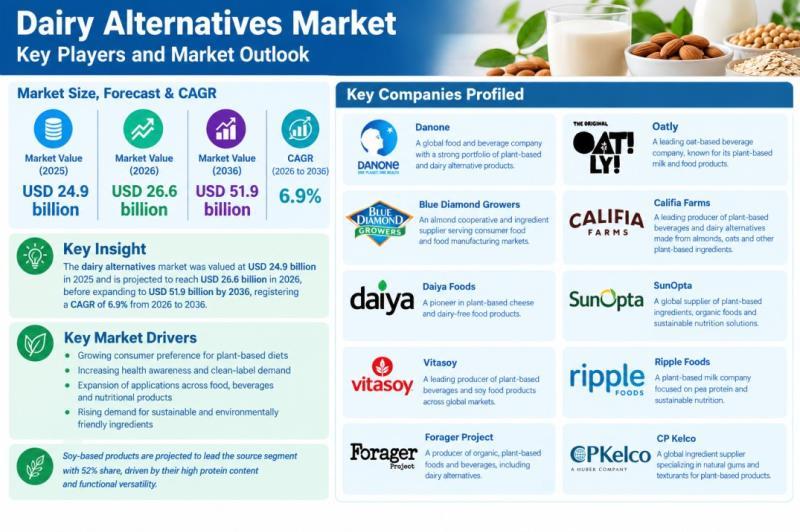
NEWARK, Del., October 13, 2026. — The global Dairy Alternatives Market was valued at USD 24.9 billion in 2025 and is projected to reach USD 26.6 billion in 2026, before expanding to USD 51.9 billion by 2036, registering a CAGR of 6.9% from 2026 to 2036, according to Future Market Insights (FMI).
The growth outlook is being shaped by increasing consumer interest in plant-based diets, demand for dairy-free beverages and growing availability of alternatives across retail and foodservice channels. FMI identifies the rising consumption of plant-based milk, expanding private-label offerings and improvements in taste, nutrition and product functionality as key growth drivers. Manufacturers are broadening their portfolios across milk, yogurt, cheese and ice cream alternatives to meet consumer expectations for convenient, affordable and nutritionally competitive dairy replacements.
👉 Get Detailed Market Forecasts, Competitive Benchmarking & Industry Insights: https://www.futuremarketinsights.com/reports/sample/rep-gb-4852
Taste, nutrition and retail accessibility shape dairy alternative purchasing
Food and beverage manufacturers are placing greater emphasis on taste, nutritional value, affordability and product performance when developing dairy alternatives. FMI projects that soy-based products will account for 52.0% of source segment demand in 2026, while non-dairy milk is expected to represent 71.0% of the market. Supermarkets and hypermarkets are projected to account for 35.0% of distribution channel demand in 2026, supported by product visibility, retail accessibility and opportunities for repeat purchases.
Consumer purchasing patterns also highlight the importance of selecting the right plant base for individual applications. In the United States, plant-based milk generated USD 2.7 billion in retail sales in 2025, accounting for 13.0% of total milk dollar sales and 12.0% of unit sales. Within plant-based milk, almond represented 49.0% of unit sales, followed by oat at 21.0% and soy at 8.0%. These differences illustrate how taste preferences, nutritional positioning and intended use influence product selection and shelf performance.
Where growth is fastest
· Germany — 9.0% CAGR: Growth is expected to benefit from private-label expansion, established demand for plant-based products and evolving requirements governing dairy-related terminology. Retailers and manufacturers are positioned to strengthen offerings across plant-based milk and other dairy alternative categories.
· India — 7.0% CAGR: Market expansion is expected to be supported by growing awareness of plant-based foods and greater consumer confidence in appropriately labeled products. Vegan logo endorsement and clearer product information can help shoppers identify suitable dairy alternatives.
· United States: Demand is supported by established plant-based milk consumption, expanding product variety and continued innovation in almond, oat and soy beverages. New protein-enriched products and flavored alternatives are broadening consumer choice.
· Europe: Private-label products and barista-style beverages are supporting market development. Germany, France and the United Kingdom represent important markets for plant-based product innovation, retail expansion and evolving dairy terminology requirements.
What leads the market
· Soy-based products — 52.0% share in 2026: Protein content, established consumer familiarity and versatility across food and beverage applications support the projected leading position of soy-based alternatives.
· Non-dairy milk — 71.0% share in 2026: Plant-based milk remains the principal dairy replacement category, supported by everyday use in coffee, cereal, beverages and home cooking.
· Supermarkets and hypermarkets — 35.0% share in 2026: Retail visibility, broad product availability and opportunities to compare brands and prices support the channel's projected leading position.
· Non-dairy yogurt and ice cream: These categories provide additional growth opportunities as consumers seek alternatives across a wider range of traditional dairy products.
· Barista and foodservice formulations: Oat-based beverages and specialized blends are gaining relevance because their foaming and heat-handling properties can support coffee preparation and other foodservice applications.
The hurdle
Price competition, product functionality and labeling requirements remain key challenges. Dairy alternative manufacturers must balance ingredient costs, nutritional profiles and taste expectations while delivering products that perform consistently across different applications. Plant-based beverages intended for coffee, for example, require suitable foaming and heat stability, while yogurt and cheese alternatives must address texture, flavor and formulation requirements.
Regulatory clarity and dairy terminology rules are also important considerations as manufacturers expand across international markets. Differences in labeling requirements can affect packaging, marketing claims and product positioning. At the same time, private-label expansion is increasing price competition, requiring branded suppliers to demonstrate clear value through nutrition, flavor and product quality.
Companies that strengthen formulation capabilities, improve manufacturing efficiency and offer products suited to local consumer preferences can reinforce their competitive position in the dairy alternatives market.
For full coverage of the Dairy Alternatives Market, including forecasts by source, product type, distribution channel, region and country, visit the FMI report: https://www.futuremarketinsights.com/reports/dairy-alternatives-market
Key market developments and demand trends
The dairy alternatives market is benefiting from broader changes in consumer nutrition, foodservice requirements and retail strategies:
· Plant-based milk adoption: Growing consumption of dairy-free beverages across coffee, cereal and home cooking is supporting demand for almond, oat and soy alternatives.
· Nutritional enhancement: Manufacturers are introducing protein-enriched and nutritionally differentiated beverages to appeal to consumers seeking alternatives that deliver more than basic dairy replacement.
· Private-label expansion: Retailers are broadening affordable plant-based ranges to attract price-conscious shoppers and encourage repeat purchases.
· Foodservice and barista applications: Oat-based beverages and specialized blends are helping meet requirements for foaming, heating and performance in coffee-based drinks.
· Expansion beyond milk: Non-dairy yogurt, cheese and ice cream are creating opportunities to increase consumer adoption across multiple food categories.
· Regulatory and labeling developments: Greater attention to dairy terminology, ingredient declarations and vegan product identification is influencing product positioning and market access.
Key developments in the Dairy Alternatives Market
Recent company developments highlight ongoing product innovation and manufacturing investment across the sector:
· January 2026: Califia Farms launched Simple & Organic Soymilk, offering 8 grams of protein per serving, alongside new creamer flavors.
· February 2026: Blue Diamond Growers introduced Blue Diamond Almondmilk in four 48-ounce varieties, including Chocolate Protein with 8 grams of plant protein.
· March 2026: Oatly announced a USD 16 million investment in Landskrona to increase annual production capacity from 150 million liters to 200 million liters.
These developments reflect a growing focus on nutritional differentiation, portfolio expansion and production capacity as manufacturers compete for a larger share of the dairy alternatives market.
Key players in the Dairy Alternatives Market
FMI identifies several companies participating in the global dairy alternatives and plant-based ingredient landscape, including:
Major global players
· Danone: A major food company with plant-based beverage and dairy alternative offerings across multiple markets.
· Oatly Group AB: Specializes in oat-based beverages and related products for retail and foodservice applications.
· Blue Diamond Growers: Offers almond-based beverages and other almond products, including plant-based milk alternatives.
· Califia Farms: Develops plant-based beverages, creamers and other dairy alternative products.
· Daiya Foods: Focuses on dairy-free foods, including plant-based cheese alternatives and other specialty products.
Specialist and regional players
· SunOpta: Supports the plant-based beverage market through ingredient processing and manufacturing capabilities, including private-label production.
· Vitasoy International Holdings Limited: Supplies soy-based beverages and other plant-based food products.
· Ripple Foods: Develops plant-based milk and protein-focused alternatives.
· Forager Project: Offers plant-based products, including dairy-free yogurt and beverage alternatives.
· CP Kelco: Supplies specialty ingredients used in food formulation, including ingredients relevant to texture and stability in dairy alternative applications.
Analyst perspective
“The opportunity in dairy alternatives is no longer only about removing milk. I see the market moving toward everyday formats that match dairy on taste, nutrition and price. Suppliers that can prove repeat purchase in milk, yogurt and cheese formats will shape the next ten years of category value.”
— Nandini Roy Choudhury, Principal Consultant, Future Market Insights.
What this means for dairy alternative manufacturers and suppliers
· Prioritize taste and nutritional performance. Developing products with appealing flavor, suitable protein content and balanced nutritional profiles can help encourage repeat purchases.
· Expand beyond plant-based milk. Investment in non-dairy yogurt, cheese and ice cream can help manufacturers capture additional consumer spending across dairy replacement categories.
· Strengthen private-label capabilities. Efficient manufacturing and flexible product development can help suppliers meet retailer demand for affordable plant-based alternatives.
· Optimize foodservice formulations. Barista-style beverages with appropriate foaming and heat stability can support growth in coffee shops and other foodservice settings.
· Adapt to regional regulations. Monitoring labeling rules and dairy terminology requirements can help manufacturers reduce compliance risks and improve market access.
· Invest in differentiated product innovation. Protein-enriched beverages, specialized plant bases and application-specific formulations can help brands distinguish their offerings in increasingly competitive retail markets.
Related Reports:
Pea Fiber Market https://www.futuremarketinsights.com/reports/pea-fiber-market
Moonshine Market https://www.futuremarketinsights.com/reports/moonshine-market
Animal Feed Probiotic Market https://www.futuremarketinsights.com/reports/animal-feed-probiotics-market
Pet Food Ingredients Market https://www.futuremarketinsights.com/reports/pet-food-ingredients-market
Egg Powder Market https://www.futuremarketinsights.com/reports/egg-powder-market
Confectionery Market https://www.futuremarketinsights.com/reports/asean-confectionery-market
About Future Market Insights
Future Market Insights, Inc. (FMI) is an ESOMAR-certified market research and consulting firm headquartered in Delaware, USA, with offices in the United Kingdom, the United Arab Emirates and India. FMI delivers syndicated and custom research across food and beverage, healthcare, chemicals, technology, packaging, consumer goods and industrial sectors.
For Press & Corporate Inquiries
Rahul Singh
AVP – Marketing and Growth Strategy
Future Market Insights, Inc.
+91 8600020075
For Sales: sales@futuremarketinsights.com
For Media: Rahul.singh@futuremarketinsights.com
For Web: https://www.futuremarketinsights.com/
Bub
Do?

Catégories
Lire la suite
Exciting news for Fortnite fans as the game gears up for its next chapter, promising new collaborations and thrilling crossover events. Among the most anticipated is the partnership with the iconic film franchise, Kill Bill, which will introduce fresh content and skins to the battle royale universe. The recent mini-season featuring a Springfield-themed map and characters has captured player...

A coalition of civil society organizations in Switzerland is raising alarms over proposed legislative changes that threaten individual privacy and civil liberties. The government’s draft legislation aims to significantly expand data retention requirements for digital communication services, including VPNs, messaging platforms, and social media outlets. Leading human rights groups, such...
September's Netflix arrivals offer a curated escape into diverse cinematic worlds, blending timeless classics with hidden gems. Experience the emotional depth of Iranian society in 'About Elly'. This compelling drama follows three couples on a seaside holiday, where the arrival of a mysterious guest unravels complex social tensions and personal secrets. For a stylish dose of inspiration, 'Iris'...
The latest Fortnite update kicks off the new year with a major cartoon crossover. South Park characters have officially rolled into the item shop, bringing themed gear with them. Beyond the shop, a fresh 'Born in Chaos' mini-pass offers players a way to earn free rewards. This pass provides a new avenue to collect exclusive items tied to the popular animated series. Three new South...
Thị trường trực tuyến hiện nay có nhiều Trang cá độ bóng đá với cách xây dựng giao diện và hệ thống tính năng khác nhau. Chính sự đa dạng này khiến người dùng cần xác định rõ những tiêu chí quan trọng trước khi lựa chọn nền tảng phù hợp. Một trang được đánh giá tốt...