


 Crypto.
 Über
Über
 Passport
 Conference call
 send money
 Bedingungen
 Datenschutz
 Sierra market
Japan AI-Enabled Digital Stethoscope Market Expands at 8.5% CAGR
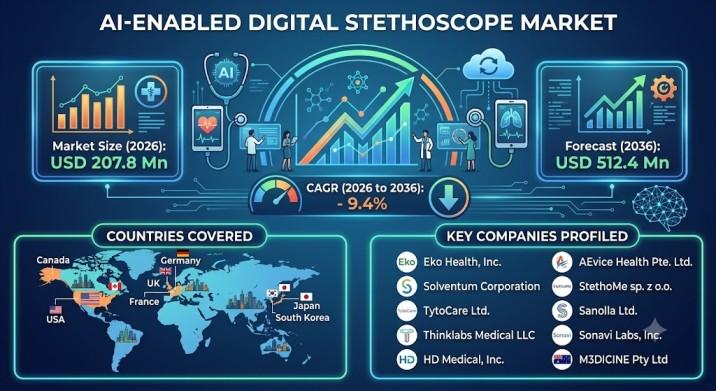
Newark, Del. — The global AI-enabled digital stethoscope market is projected to grow from USD 207.8 million in 2026 to USD 512.4 million by 2036, registering a compound annual growth rate (CAGR) of 9.4%, according to Future Market Insights (FMI). The market was valued at USD 189.9 million in 2025, with an estimated incremental revenue opportunity of USD 304.6 million between 2026 and 2036.
AI-enabled digital stethoscopes combine electronic sound capture with software that analyzes heart or lung sounds for specified clinical functions. These systems can help clinicians identify findings that may warrant further assessment, but they do not replace clinical judgment or confirmatory diagnostic procedures.
👉 Get Detailed Market Forecasts, Competitive Benchmarking, and Pricing Trends:
https://www.futuremarketinsights.com/reports/sample/rep-gb-35764
The commercial opportunity is being shaped by the availability of clinically evaluated algorithms, regulatory clearances and established workflows for reviewing abnormal findings. For healthcare providers, the value of a device depends not only on sound acquisition but also on whether its results can be translated into appropriate follow-up.
Where Growth Is Fastest
FMI's forecasts for 2026–2036 show the United Kingdom leading the profiled countries, followed by Germany and France.
· United Kingdom – CAGR 12.2%: AI-assisted heart examinations in primary care and planned clinical AI procurement frameworks support demand. Training, clinical workflow integration and access to follow-up services remain important to routine use.
· Germany – CAGR 11.3%: Demand is expected to benefit from clinical adoption of digital diagnostic technologies, with product registration, documentation and function-specific regulatory requirements influencing purchasing decisions.
· France – CAGR 10.2%: Wider use of digital clinical tools creates opportunities for AI-assisted auscultation, although product eligibility and integration into clinical practice will influence adoption.
· United States – CAGR 9.4%: New electronic stethoscope clearances and AI-supported cardiac screening functions are expanding the range of clinician-operated products available for evaluation.
· Japan – CAGR 8.5%: Investment and collaboration involving digital health developers may support local market entry, particularly for connected respiratory monitoring.
· South Korea – CAGR 7.6%: The country's digital medical product framework makes local classification, supporting evidence and regulatory compliance important for commercialization.
· Canada – CAGR 6.7%: Guidance for machine-learning-enabled medical devices emphasizes intended use, representative data, clinical validation and lifecycle controls.
These figures are market forecasts, not guarantees of commercial performance or measures of current clinical adoption.
What Leads the Market
FMI's 2026 estimates identify four leading market categories:
· Product type: Handheld digital stethoscopes are projected to account for 59.8% of revenue.
· AI function: Cardiac murmur and arrhythmia detection is expected to represent 47.5% of revenue.
· End user: Hospitals and clinics are projected to account for 52.5% of revenue.
· Sales channel: Direct sales and medical distributors are expected to hold a 61.6% share.
Handheld devices retain an advantage because clinicians can collect sounds during familiar examination routines and repeat recordings when needed. AI functions for cardiac murmurs and rhythm assessment may help identify patients who require further evaluation, while compatible respiratory analysis tools extend the technology into lung-sound assessment.
Hospitals and clinics remain important buyers because they have trained personnel and access to confirmatory services such as echocardiography. Direct sales and medical distributors also play a significant role because institutional buyers may need guidance on compatible hardware, software, intended use and staff training.
The Hurdle
Clinical performance and follow-up capacity remain important barriers to broader adoption. A February 2026 study involving 357 adults aged 50 years and older reported sensitivity of 92.3% for AI-assisted auscultation, compared with 46.2% for usual assessment. However, the study also reported specificity of 86.9% for AI-assisted auscultation, compared with 95.6% for usual assessment.
The findings illustrate a practical trade-off: identifying more potentially significant cases may also increase the number of patients referred for confirmatory testing. Healthcare providers must therefore consider how alerts are interpreted, who reviews results and whether diagnostic services can accommodate additional referrals. The study findings should not be generalized to every device, algorithm or patient population.
Regulatory clearance is another consideration. Authorization applies to a defined device and intended use; clearance for one cardiac or respiratory function does not automatically authorize other AI functions. Manufacturers must provide appropriate evidence, communicate limitations and maintain the controls required for the relevant market.
👉 Access the Complete Report in PDF Format:
https://www.futuremarketinsights.com/reports/brochure/rep-gb-35764
Industry Investment and Recent Developments
Recent product and regulatory developments illustrate the expansion of AI-assisted auscultation.
· June 2026 – TytoCare: The company received FDA clearance for an updated Tyto Insights for Wheeze Detection submission. The clearance included a predetermined change control plan for eligible algorithm changes, supporting continued development within the authorized scope.
· May 2026 – AiSteth: The FDA cleared AiSteth as a Class II electronic stethoscope, adding another clinician-operated product to the market.
· July 2026 – CORE 300: The FDA cleared the CORE 300 Digital Stethoscope as a Class II electronic stethoscope.
· August 2025 – Eko Health: The FDA cleared EFAST for cardiac sound analysis and ECG-dependent rhythm assessment under its specified labeling.
· September 2025 – Sanolla: The company opened direct physician sales of VoqX, offering full-spectrum auscultation and on-device support.
These developments relate to specific products and functions; they should not be interpreted as blanket authorization for AI-based diagnosis across all clinical uses.
Analyst Perspective
“Recorded auscultation will gain demand where abnormal findings can move directly towards imaging and specialist review. Lower specificity will keep clinical follow-up capacity as the main factor separating routine adoption from trial use.”
— Anurag Sharma, Principal Consultant, Future Market Insights.
What This Means for Healthcare Providers and Manufacturers
For healthcare providers, AI-enabled stethoscopes offer another tool for collecting and reviewing physiological sounds, particularly when screening can be integrated into established examination and referral pathways. Buyers should evaluate the specific intended use, clinical evidence, compatibility with existing systems, user training requirements and the capacity to follow up on abnormal results.
For manufacturers, opportunities extend beyond the acoustic hardware. Algorithm performance, software updates, regulatory documentation and interoperability can influence purchasing decisions. Partnerships with healthcare providers may also help establish workflows that connect screening results to appropriate clinical assessment.
The market's growth will depend on whether suppliers can demonstrate reliable performance for specific uses and help healthcare organizations incorporate AI-assisted auscultation into practical, clinically supervised workflows.
Read the full report: https://www.futuremarketinsights.com/reports/ai-enabled-digital-stethoscope-market
AI-Enabled Digital Stethoscope Market – Report Scope
The FMI report covers the global market from 2026 to 2036, including human-use AI-enabled digital stethoscopes, attachable digital chestpiece modules, acoustic wearables and patches, and eligible dedicated AI licenses and replacement products.
· Product types: Handheld digital stethoscopes, clinician-grade electronic stethoscopes, attachable digital chestpiece modules, wearable and patch auscultation devices, home-use telehealth stethoscopes and remote patient-monitoring stethoscopes.
· AI functions: Cardiac murmur and arrhythmia detection, structural heart disease screening, atrial fibrillation detection, heart failure and low ejection fraction screening, pulmonary sound analysis and other AI functions.
· End users: Hospitals and clinics, primary care practices, cardiology departments, telehealth and homecare, academic and training institutions, and ambulatory and emergency services.
· Sales channels: Direct sales and medical distributors, hospital tender sales, online retail, and group purchasing and telehealth bundles.
· Key companies profiled: Eko Health, Inc.; Solventum Corporation; TytoCare Ltd.; Thinklabs Medical LLC; HD Medical, Inc.; AEvice Health Pte. Ltd.; StethoMe sp. z o.o.; Sanolla Ltd.; Sonavi Labs, Inc.; and M3DICINE Pty Ltd.
· Forecast period: 2026–2036.
Related Reports:
· Optogenetics Actuators Sensors Market - https://www.futuremarketinsights.com/reports/optogenetics-actuators-sensors-market
· Comprehensive Metabolic Panel Cmp Testing Market - https://www.futuremarketinsights.com/reports/comprehensive-metabolic-panel-cmp-testing-market
· EZH2 Inhibitors Market - https://www.futuremarketinsights.com/reports/ezh2-inhibitors-market
About Future Market Insights
Future Market Insights, Inc. (FMI) is an ESOMAR-certified market research and consulting firm headquartered in Delaware, USA, with offices in the United Kingdom, the United Arab Emirates and India. FMI delivers syndicated and custom research across food and beverage, healthcare, chemicals, technology, packaging, consumer goods and industrial sectors.
Media Contact
Future Market Insights, Inc.
Newark, Del. — The global AI-enabled digital stethoscope market is projected to grow from USD 207.8 million in 2026 to USD 512.4 million by 2036, registering a compound annual growth rate (CAGR) of 9.4%, according to Future Market Insights (FMI). The market was valued at USD 189.9 million in 2025, with an estimated incremental revenue opportunity of USD 304.6 million between 2026 and 2036.
AI-enabled digital stethoscopes combine electronic sound capture with software that analyzes heart or lung sounds for specified clinical functions. These systems can help clinicians identify findings that may warrant further assessment, but they do not replace clinical judgment or confirmatory diagnostic procedures.
👉 Get Detailed Market Forecasts, Competitive Benchmarking, and Pricing Trends:
https://www.futuremarketinsights.com/reports/sample/rep-gb-35764
The commercial opportunity is being shaped by the availability of clinically evaluated algorithms, regulatory clearances and established workflows for reviewing abnormal findings. For healthcare providers, the value of a device depends not only on sound acquisition but also on whether its results can be translated into appropriate follow-up.
Where Growth Is Fastest
FMI's forecasts for 2026–2036 show the United Kingdom leading the profiled countries, followed by Germany and France.
· United Kingdom – CAGR 12.2%: AI-assisted heart examinations in primary care and planned clinical AI procurement frameworks support demand. Training, clinical workflow integration and access to follow-up services remain important to routine use.
· Germany – CAGR 11.3%: Demand is expected to benefit from clinical adoption of digital diagnostic technologies, with product registration, documentation and function-specific regulatory requirements influencing purchasing decisions.
· France – CAGR 10.2%: Wider use of digital clinical tools creates opportunities for AI-assisted auscultation, although product eligibility and integration into clinical practice will influence adoption.
· United States – CAGR 9.4%: New electronic stethoscope clearances and AI-supported cardiac screening functions are expanding the range of clinician-operated products available for evaluation.
· Japan – CAGR 8.5%: Investment and collaboration involving digital health developers may support local market entry, particularly for connected respiratory monitoring.
· South Korea – CAGR 7.6%: The country's digital medical product framework makes local classification, supporting evidence and regulatory compliance important for commercialization.
· Canada – CAGR 6.7%: Guidance for machine-learning-enabled medical devices emphasizes intended use, representative data, clinical validation and lifecycle controls.
These figures are market forecasts, not guarantees of commercial performance or measures of current clinical adoption.
What Leads the Market
FMI's 2026 estimates identify four leading market categories:
· Product type: Handheld digital stethoscopes are projected to account for 59.8% of revenue.
· AI function: Cardiac murmur and arrhythmia detection is expected to represent 47.5% of revenue.
· End user: Hospitals and clinics are projected to account for 52.5% of revenue.
· Sales channel: Direct sales and medical distributors are expected to hold a 61.6% share.
Handheld devices retain an advantage because clinicians can collect sounds during familiar examination routines and repeat recordings when needed. AI functions for cardiac murmurs and rhythm assessment may help identify patients who require further evaluation, while compatible respiratory analysis tools extend the technology into lung-sound assessment.
Hospitals and clinics remain important buyers because they have trained personnel and access to confirmatory services such as echocardiography. Direct sales and medical distributors also play a significant role because institutional buyers may need guidance on compatible hardware, software, intended use and staff training.
The Hurdle
Clinical performance and follow-up capacity remain important barriers to broader adoption. A February 2026 study involving 357 adults aged 50 years and older reported sensitivity of 92.3% for AI-assisted auscultation, compared with 46.2% for usual assessment. However, the study also reported specificity of 86.9% for AI-assisted auscultation, compared with 95.6% for usual assessment.
The findings illustrate a practical trade-off: identifying more potentially significant cases may also increase the number of patients referred for confirmatory testing. Healthcare providers must therefore consider how alerts are interpreted, who reviews results and whether diagnostic services can accommodate additional referrals. The study findings should not be generalized to every device, algorithm or patient population.
Regulatory clearance is another consideration. Authorization applies to a defined device and intended use; clearance for one cardiac or respiratory function does not automatically authorize other AI functions. Manufacturers must provide appropriate evidence, communicate limitations and maintain the controls required for the relevant market.
👉 Access the Complete Report in PDF Format:
https://www.futuremarketinsights.com/reports/brochure/rep-gb-35764
Industry Investment and Recent Developments
Recent product and regulatory developments illustrate the expansion of AI-assisted auscultation.
· June 2026 – TytoCare: The company received FDA clearance for an updated Tyto Insights for Wheeze Detection submission. The clearance included a predetermined change control plan for eligible algorithm changes, supporting continued development within the authorized scope.
· May 2026 – AiSteth: The FDA cleared AiSteth as a Class II electronic stethoscope, adding another clinician-operated product to the market.
· July 2026 – CORE 300: The FDA cleared the CORE 300 Digital Stethoscope as a Class II electronic stethoscope.
· August 2025 – Eko Health: The FDA cleared EFAST for cardiac sound analysis and ECG-dependent rhythm assessment under its specified labeling.
· September 2025 – Sanolla: The company opened direct physician sales of VoqX, offering full-spectrum auscultation and on-device support.
These developments relate to specific products and functions; they should not be interpreted as blanket authorization for AI-based diagnosis across all clinical uses.
Analyst Perspective
“Recorded auscultation will gain demand where abnormal findings can move directly towards imaging and specialist review. Lower specificity will keep clinical follow-up capacity as the main factor separating routine adoption from trial use.”
— Anurag Sharma, Principal Consultant, Future Market Insights.
What This Means for Healthcare Providers and Manufacturers
For healthcare providers, AI-enabled stethoscopes offer another tool for collecting and reviewing physiological sounds, particularly when screening can be integrated into established examination and referral pathways. Buyers should evaluate the specific intended use, clinical evidence, compatibility with existing systems, user training requirements and the capacity to follow up on abnormal results.
For manufacturers, opportunities extend beyond the acoustic hardware. Algorithm performance, software updates, regulatory documentation and interoperability can influence purchasing decisions. Partnerships with healthcare providers may also help establish workflows that connect screening results to appropriate clinical assessment.
The market's growth will depend on whether suppliers can demonstrate reliable performance for specific uses and help healthcare organizations incorporate AI-assisted auscultation into practical, clinically supervised workflows.
Read the full report: https://www.futuremarketinsights.com/reports/ai-enabled-digital-stethoscope-market
AI-Enabled Digital Stethoscope Market – Report Scope
The FMI report covers the global market from 2026 to 2036, including human-use AI-enabled digital stethoscopes, attachable digital chestpiece modules, acoustic wearables and patches, and eligible dedicated AI licenses and replacement products.
· Product types: Handheld digital stethoscopes, clinician-grade electronic stethoscopes, attachable digital chestpiece modules, wearable and patch auscultation devices, home-use telehealth stethoscopes and remote patient-monitoring stethoscopes.
· AI functions: Cardiac murmur and arrhythmia detection, structural heart disease screening, atrial fibrillation detection, heart failure and low ejection fraction screening, pulmonary sound analysis and other AI functions.
· End users: Hospitals and clinics, primary care practices, cardiology departments, telehealth and homecare, academic and training institutions, and ambulatory and emergency services.
· Sales channels: Direct sales and medical distributors, hospital tender sales, online retail, and group purchasing and telehealth bundles.
· Key companies profiled: Eko Health, Inc.; Solventum Corporation; TytoCare Ltd.; Thinklabs Medical LLC; HD Medical, Inc.; AEvice Health Pte. Ltd.; StethoMe sp. z o.o.; Sanolla Ltd.; Sonavi Labs, Inc.; and M3DICINE Pty Ltd.
· Forecast period: 2026–2036.
Related Reports:
· Optogenetics Actuators Sensors Market - https://www.futuremarketinsights.com/reports/optogenetics-actuators-sensors-market
· Comprehensive Metabolic Panel Cmp Testing Market - https://www.futuremarketinsights.com/reports/comprehensive-metabolic-panel-cmp-testing-market
· EZH2 Inhibitors Market - https://www.futuremarketinsights.com/reports/ezh2-inhibitors-market
About Future Market Insights
Future Market Insights, Inc. (FMI) is an ESOMAR-certified market research and consulting firm headquartered in Delaware, USA, with offices in the United Kingdom, the United Arab Emirates and India. FMI delivers syndicated and custom research across food and beverage, healthcare, chemicals, technology, packaging, consumer goods and industrial sectors.
Media Contact
Future Market Insights, Inc.
Email: sales@futuremarketinsights.com
Phone: +1-347-918-3531
Email: sales@futuremarketinsights.com
Phone: +1-347-918-3531
Bub
Do?

Kategorien
Mehr lesen
Dalam beberapa tahun terakhir, penggunaan internet mengalami pertumbuhan yang sangat pesat. Berbagai aktivitas kini dilakukan secara online, mulai dari mencari informasi hingga bergabung dengan komunitas yang memiliki minat yang sama. Perubahan ini membuat masyarakat semakin membutuhkan platform yang mampu memberikan pengalaman digital yang nyaman dan mudah digunakan. Salah satu nama yang mulai...

Vielseitiges Ditto-Deck Mit einem vielseitigen Ditto-Deck kannst du dein Pokémon TCG Pocket-Spiel dominieren, indem du die Fähigkeiten deines kleinen Transformers optimal nutzt. Ditto ist berühmt dafür, sich in andere Pokémon zu verwandeln und deren Stärken sowie Schwächen zu übernehmen. Diese einzigartige Fähigkeit kommt deinem Deck zugute,...
Emergen Research is proud to release its latest series of market research reports, offering businesses a detailed roadmap for growth and strategic decision-making. The reports provide a deep dive into industry trends, competitive landscapes, emerging opportunities, and market challenges, ensuring that companies are equipped with actionable insights. By analyzing both micro and macroeconomic...

UK officials confirm virtual private networks remain lawful tools, though authorities acknowledge monitoring their application patterns with heightened scrutiny. Consumer adoption of VPN services has demonstrated substantial growth across Britain, notably accelerating after July 25th age verification mandates took effect. Science Secretary Peter Kyle explicitly denied any imminent...
In 7 Days To Die, relying on looted food and water is risky; you will often find dirty water or random ingredients, and dysentery or starvation is a real threat. Farming is essential because looted supplies are unreliable, making a steady food supply critical for survival. This guide covers the essentials of planting, growing, and harvesting crops so you can thrive in the wasteland. Crafting...
