


 Crypto.
 О нас
О нас
 Passport
 Conference call
 send money
 Условия использования
 Конфиденциальность
 Sierra market
Silent Scan Technology Market Advances with Acoustic Noise Reduction
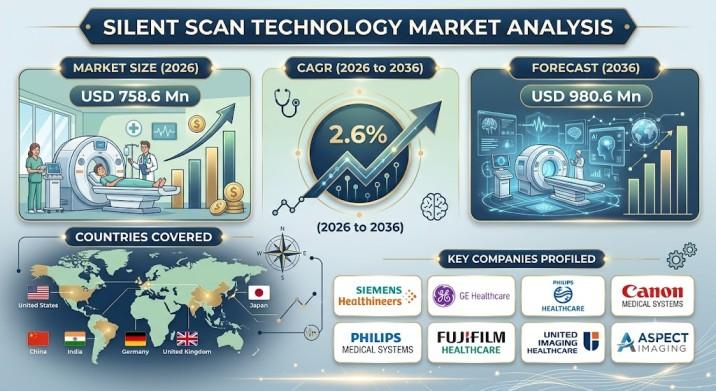
The global silent scan technology market is projected to grow from USD 758.6 million in 2026 to USD 980.6 million by 2036, registering a compound annual growth rate (CAGR) of 2.6%, according to Future Market Insights (FMI). The market was valued at USD 739.4 million in 2025.
Silent scan technology aims to reduce the acoustic noise generated during magnetic resonance imaging (MRI), helping improve the scanning experience while maintaining diagnostic image quality. Hospitals and diagnostic imaging centres are evaluating these technologies as part of equipment upgrades, particularly for examinations involving children, patients with anxiety and people who may find conventional MRI procedures difficult to tolerate.
FMI expects 1.5T MRI scanners to account for 57.0% of product-type demand in 2026. Hospitals are projected to represent 64.0% of end-user demand, while neurology imaging is forecast to account for 43.5% of application demand.
👉 Get Detailed Market Forecasts, Competitive Benchmarking, and Pricing Trends:
https://www.futuremarketinsights.com/reports/sample/rep-gb-1623
Why the Silent Scan Technology Market Is Growing
Conventional MRI examinations can generate substantial acoustic noise from rapidly switched gradient coils. This noise may cause discomfort or anxiety and can make examinations more challenging for some patients. Noise-reduction techniques seek to improve the patient experience while preserving the image quality required for clinical interpretation.
Patient comfort is particularly relevant in pediatric imaging and certain neurological examinations. Reducing noise may help some patients tolerate a scan, although the need for sedation depends on the patient's age, clinical circumstances and ability to remain still.
Hospitals are also considering how quiet imaging fits into broader MRI upgrade plans. Buyers evaluate noise reduction alongside image quality, scan duration, equipment reliability, service support and compatibility with existing clinical workflows. These factors influence whether a provider purchases a new MRI platform or upgrades an installed system.
Where Growth Is Fastest
FMI's country forecasts show India leading the markets listed in its report, followed by China and Germany.
· India — 7.8% CAGR: Private healthcare investment and expansion of MRI capacity are expected to support demand for quieter imaging systems.
· China — 6.9% CAGR: Hospital infrastructure development and imaging-equipment procurement are projected to support market expansion.
· Germany — 4.6% CAGR: Established hospital imaging infrastructure and structured equipment purchasing are expected to support adoption.
· United States — 3.1% CAGR: Replacement cycles and hospital procurement programs are expected to sustain demand.
· United Kingdom — 2.2% CAGR: Structured purchasing and budget considerations are expected to influence adoption.
India's forecast growth rate is notably higher than the global market's 2.6% CAGR. However, growth rates alone do not establish which country will generate the highest absolute revenue; that comparison requires country-level market values.
What Leads the Market
FMI's 2026 estimates identify the following leading segments:
· 1.5T MRI scanners — 57.0%: Their broad clinical application range and substantial installed base support their leading position.
· Hospitals — 64.0%: Hospital radiology departments account for the largest share of end-user demand.
· Neurology imaging — 43.5%: Brain MRI examinations and neurological imaging needs support demand for quieter scanning technologies.
· Noise-reduction technology — 47.0%: Acoustic noise management is a central feature driving interest in silent scan systems.
· Adult patients — 61.7%: Adults account for the largest share of patient-type demand, while pediatric imaging remains an important use case for patient-comfort improvements.
These percentages refer to different segmentation categories and should not be added together.
The Hurdle: Capital Costs and System Compatibility
New MRI platforms require substantial capital investment, and hospitals must balance imaging upgrades against competing equipment needs. Even where quieter scanning is desirable, the business case depends on the expected clinical and operational benefits, the age of existing equipment and available budgets.
Compatibility is another consideration. Hospitals need to determine whether noise-reduction capabilities are available for their installed systems, whether an upgrade requires hardware changes and how the technology affects established imaging protocols.
Manufacturers must also demonstrate that noise reduction does not compromise the image quality required for a given examination. For buyers, evaluation should cover clinical performance, installation requirements, staff training, maintenance and total cost of ownership rather than acoustic performance alone.
👉 Access the Complete Report in PDF Format:
https://www.futuremarketinsights.com/reports/brochure/rep-gb-1623
Industry Competition and Technology Developments
The market includes established MRI manufacturers and companies developing specialized imaging systems. FMI identifies the following companies among the participants:
· Siemens Healthineers
· GE HealthCare
· Philips Healthcare
· Canon Medical Systems
· Fujifilm Healthcare
· United Imaging Healthcare
· Aspect Imaging
· Hyperfine Research
The competitive focus includes quiet MRI sequences, acoustic noise reduction, AI-assisted image reconstruction and system designs intended to improve the patient experience. Established manufacturers can draw on installed MRI platforms and service networks, while specialized suppliers focus on particular imaging needs and system categories.
For healthcare providers, the relevant comparison is not simply whether a scanner is quieter. Procurement teams must assess noise reduction alongside image quality, scan protocols, compatibility, service coverage and the clinical requirements of the patients they serve.
What This Means for Hospitals and MRI Manufacturers
For hospitals, silent scan technology is one option for improving the MRI experience, particularly in settings where patient anxiety or difficulty tolerating noise can complicate examinations. Investment decisions should consider the patient population, imaging workload, existing equipment and evidence of clinical and operational benefits.
For manufacturers, the forecast points to opportunities in noise-reduction capabilities, system upgrades and technologies that combine patient comfort with dependable image reconstruction. Strong service support and compatibility with clinical workflows will remain important to purchasing decisions.
Although the market is projected to grow at a moderate global rate, faster forecast growth in India and China indicates opportunities in markets expanding their imaging capacity. Suppliers will need to match their offerings to local budgets, procurement practices and service requirements.
Read the full report: https://www.futuremarketinsights.com/reports/silent-scan-technology-market
Report Scope
Future Market Insights' Silent Scan Technology Market report covers the 2026–2036 forecast period and analyzes the market by:
· Product type: 1.5T MRI scanners and 3T MRI scanners.
· End user: Hospitals, diagnostic imaging centres and ambulatory surgical centres.
· Application: Neurology imaging, orthopaedic imaging and cardiovascular imaging.
· Technology: Noise-reduction technology, AI-integrated MRI systems and advanced gradient technology.
· Patient type: Adult patients, pediatric patients and critical-care patients.
· Regions: North America, Latin America, Western Europe, Eastern Europe, East Asia, South Asia and Pacific, and the Middle East and Africa.
Related Reports:
About Future Market Insights
Future Market Insights, Inc. (FMI) is an ESOMAR-certified market research and consulting firm headquartered in Delaware, USA, with offices in the United Kingdom, the United Arab Emirates and India. FMI delivers syndicated and custom research across food and beverage, healthcare, chemicals, technology, packaging, consumer goods and industrial sectors.
Media Contact
Future Market Insights, Inc.
Email: sales@futuremarketinsights.com
Phone: +1-347-918-3531
Bub
Do?

Категории
Больше
Netflix is embarking on an exciting new project, collaborating with renowned musical innovator Wyclef Jean to create a captivating animated musical inspired by his life story. This CG animated feature will be produced through a partnership between Netflix and Stampede, a fresh entertainment media company founded by Greg Silverman. Justin Marks, known for his work on "The Jungle Book" and "Top...

MMOEXP offers one of the most reliable solutions for purchasing game currency, items,accounts, and more. You can now use the exclusive discount code "east" to enjoy a 8% discount. Starting FC27 on the right foot is make-or-break for building a dominant squad and climbing ranks fast. But are you unknowingly making critical missteps that slow your progress? From mismanaging...

Cybercriminals Deploy Sophisticated Malware Through Deceptive Social Engineering Tactics A notorious cybercrime syndicate known as Velvet Tempest has been identified leveraging deceptive ClickFix methods alongside standard Windows tools to distribute DonutLoader malicious software and the CastleRAT remote access trojan. Security analysts from MalBeacon, a specialized cyber-deception...
Fashion is no longer simply about what people wear. It has become a powerful form of communication, a reflection of culture, and an increasingly important part of the global news cycle. From unexpected celebrity looks to major runway announcements, sustainability debates, designer changes, and viral street-style moments, fashion can become news within minutes. For readers trying to keep up,...

Um die Wunderwahl im Pokémon TCG Pocket entspannter zu gestalten, setzen viele Spieler auf einen simplen psychologischen Ansatz. Statt sich bei jeder Auswahl erneut zu stressen, wählen sie konsequent dieselbe Position aus den fünf Karten. Dies verhindert das Gefühl, nach der Wahl eine falsche Entscheidung getroffen zu haben. Die Methode hat keinen Einfluss auf das...
