


 Crypto.
 О нас
О нас
 Passport
 Conference call
 send money
 Условия использования
 Конфиденциальность
 Sierra market
Sleep Optimization Wearable Market Advances with Personalized Sleep Coaching
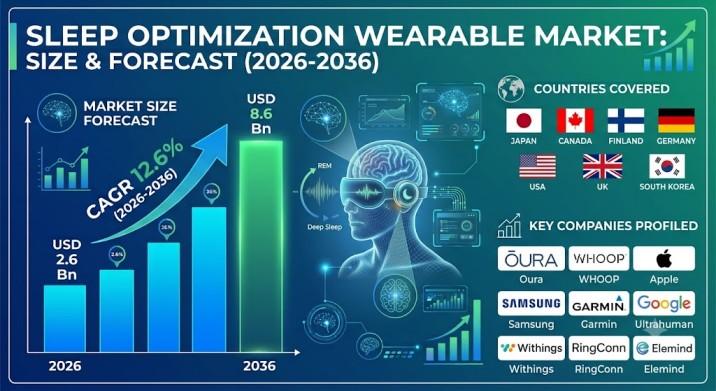
The global sleep optimization wearable market is projected to increase from USD 2.6 billion in 2026 to USD 8.6 billion by 2036, expanding at a compound annual growth rate (CAGR) of 12.6%, according to Future Market Insights (FMI). The market was valued at USD 2.3 billion in 2025, with growth supported by rising interest in tracking sleep duration, bedtime consistency and overnight recovery.
Smart rings are expected to account for 40.7% of product-type revenue in 2026, while photoplethysmography and accelerometry are projected to represent 64.5% of technology demand. Sleep tracking and insight is forecast to account for 46.5% of application revenue, and online retail is expected to hold a 62.6% share of sales.
The forecast represents an additional USD 6.0 billion in market revenue between 2026 and 2036. For manufacturers, the opportunity extends beyond device sales to include sensor improvements, battery performance, subscription services and software that makes sleep information easier to understand.
👉 Get Detailed Market Forecasts, Competitive Benchmarking, and Pricing Trends:
https://www.futuremarketinsights.com/reports/sample/rep-gb-35794
Why the Sleep Optimization Wearable Market Is Growing
Sleep optimization wearables combine sensors, software and connected applications to help users monitor sleep patterns and related wellness indicators. Smart rings, watches, wristbands and headbands offer different combinations of comfort, battery life, sensing capabilities and daytime functionality.
Consumer interest is supported by concerns about insufficient sleep and growing familiarity with personal health tracking. The US National Center for Health Statistics reported in April 2026 that 30.5% of adults in the United States slept fewer than seven hours during 2024. This public-health indicator provides context for interest in sleep monitoring, although it does not directly measure wearable purchases.
Product design is also influencing adoption. Compact rings can be worn overnight without a bright display, while wrist-based devices combine sleep tracking with activity and other wellness functions. Longer battery life can reduce interruptions caused by charging, and personalized summaries can help users interpret their recorded patterns.
For companies in this market, the challenge is to turn continuous sensor data into understandable, useful information while maintaining comfort, reliable measurement and sustained consumer engagement.
Where Growth Is Fastest
FMI’s country forecasts indicate that Japan and Canada are expected to record the strongest growth among the profiled markets during 2026–2036.
· Japan — 16.3% CAGR: Wider domestic availability of smart rings and expanded sizing options are expected to support product access and consumer trial.
· Canada — 15.1% CAGR: Public-health attention to sleep and daily movement, combined with wearable availability, is expected to support market development.
· Finland — 13.7% CAGR: Domestic wearable technology expertise and access to ring-based products are expected to contribute to demand.
· Germany — 12.6% CAGR: Consumer interest in measurable health indicators and connected wellness technologies is projected to support adoption.
· United States — 11.5% CAGR: Attention to insufficient sleep and established wearable-device adoption are expected to support continued growth.
· United Kingdom — 10.0% CAGR: Demand for everyday health and wellness monitoring is projected to support the market.
· South Korea — 8.9% CAGR: Sleep coaching and the integration of sleep features into broader fitness devices are expected to contribute to demand.
These figures represent forecast growth rates rather than current market shares. Differences in product availability, purchasing behavior, pricing and technology adoption may influence actual performance in each country.
What Leads the Market
FMI’s 2026 estimates identify five leading segments:
- Smart rings — 40.7%: Compact designs and overnight wearability support their leading position in the product category.
- Photoplethysmography and accelerometry — 64.5%: Optical pulse-related sensing and movement measurement are widely integrated into compact wearable devices.
- Sleep tracking and insight — 46.5%: Consumers use recorded sleep information to review duration, consistency and interruptions.
- Online retail — 62.6%: E-commerce and direct ordering give consumers access to product comparisons, sizing information and purchasing options.
- Wellness-focused adults — 50.9%: Everyday sleep and recovery monitoring supports demand among consumers focused on general wellness.
These percentages refer to separate market segments and should not be added together. Each represents a different category within the market’s segmentation.
The Hurdle: Measurement Confidence and Continued Use
Sleep wearables face a key challenge: consumers need to understand what their measurements mean. Device estimates can differ from laboratory-based sleep assessments, and a consumer wellness score should not be treated as a medical diagnosis.
Comfort, battery life, sensor reliability and software usability also affect whether consumers continue wearing a device every night. Smart rings require appropriate sizing and sensor contact, while watches and wristbands must balance sleep tracking with charging requirements and daytime use.
Commercial models introduce further considerations. Subscription fees may provide access to additional analysis or personalized features, but recurring costs can influence purchasing decisions and retention. Manufacturers need to demonstrate value through clear information and dependable performance rather than relying solely on increasingly detailed scores.
Industry Developments and Competitive Activity
Product launches and platform updates demonstrate how companies are competing through smaller designs, longer battery life and more accessible sleep guidance.
· January 2025 — Samsung Electronics: Samsung expanded Galaxy Ring availability to Japan and announced an expanded range of eleven sizes, according to the FMI report.
· April 2025 — Garmin: Garmin introduced vívoactive 6 with sleep score, personalized sleep coaching and a smart wake alarm. The company states that the device offers up to eleven days of battery life.
· September 2025 — Apple: Apple introduced sleep score features with Apple Watch Series 11, providing a summarized score based on sleep duration, bedtime consistency and interruptions.
· November 2025 — Oura: Oura expanded Walmart availability of Ring 4 and Ring 4 Ceramic, offering consumers another retail purchasing route.
· February 2026 — Ultrahuman: Ultrahuman announced Ring PRO with a stated battery life of up to 15 days and its Jade software.
· May 2026 — Oura: Oura introduced Ring 5, described in the FMI report as having a design 40% smaller than Ring 4 and twelve signal pathways.
· May 2026 — Google: Google announced the Google Health app as the successor to the Fitbit app.
These developments illustrate competitive activity across ring-based devices, smartwatches and software platforms. Manufacturer-stated battery life and product capabilities should be evaluated against the relevant model specifications and real-world usage conditions.
👉 Access the Complete Report in PDF Format:
https://www.futuremarketinsights.com/reports/brochure/rep-gb-35794
Competitive Landscape
FMI profiles companies across ring-based sleep tracking, wrist-worn health monitoring and emerging sleep-intervention technologies. Key participants include:
· Oura Health Oy
· WHOOP, Inc.
· Apple Inc.
· Samsung Electronics Co., Ltd.
· Garmin Ltd.
· Google LLC
· Ultrahuman Healthcare Pvt. Ltd.
· Withings SA
· RingConn Ltd.
· Elemind Technologies, Inc.
Competition spans devices focused on sleep and recovery as well as broader health and fitness platforms. Ring manufacturers emphasize overnight wearability and continuous measurement, while smartwatch companies combine sleep information with daytime activity and other features. Emerging headband technologies explore additional approaches to sleep monitoring and intervention.
For manufacturers, differentiation increasingly depends on sensor performance, comfort, battery life, software interpretation, retail access and the value of any associated membership service.
Analyst Perspective
Anurag Sharma, Principal Consultant at Future Market Insights, said: “I expect comfortable wearables with clear sleep guidance to gain stronger adoption than products offering unexplained scores. Longer battery, dependable sensing and useful morning information will decide which companies retain regular users.”
What This Means for Wearable Manufacturers and Retailers
For manufacturers, the market outlook highlights opportunities in compact sensors, comfortable overnight designs, battery improvements and software that turns recorded data into understandable summaries. Building a lasting user base may depend on making the device easy to wear and the information easy to interpret.
Retailers can support purchasing decisions by providing clear comparisons of device compatibility, sizing, battery performance, membership costs and available features. These details are especially relevant for smart rings, where fit can influence comfort and sensor contact.
For consumers, sleep wearables can provide information about personal patterns, but they should not replace professional assessment when persistent sleep problems or suspected sleep disorders require clinical attention.
With the market projected to reach USD 8.6 billion by 2036, sleep optimization wearables represent a growing consumer technology category. Long-term growth will depend on continued use, trusted measurement, product comfort and the ability of companies to deliver meaningful value beyond a nightly score.
Read the full report: https://www.futuremarketinsights.com/reports/sleep-optimization-wearable-market
Report Scope
Future Market Insights’ Sleep Optimization Wearable Market report covers the 2026–2036 forecast period and analyzes the market by:
· Product type: Smart rings, wristbands and smartwatches, headbands and neurostimulation wearables, sleep masks and earbuds.
· Technology: Photoplethysmography and accelerometry, EEG-based monitoring, temperature and respiration sensing, active intervention technologies.
· Application: Sleep tracking and insight, sleep enhancement and intervention, sleep disorder screening, performance and wellness coaching.
· Sales channel: Online retail, consumer electronics stores, specialty stores, direct-to-consumer websites.
· Consumer group: Wellness-focused adults, athletes and performance users, older adults and clinical users.
· Regions: North America, Latin America, Western Europe, Eastern Europe, East Asia, South Asia and Pacific, and the Middle East and Africa.
Related Reports:
About Future Market Insights
Future Market Insights, Inc. (FMI) is an ESOMAR-certified market research and consulting firm headquartered in Delaware, USA, with offices in the United Kingdom, the United Arab Emirates and India. FMI delivers syndicated and custom research across food and beverage, healthcare, chemicals, technology, packaging, consumer goods and industrial sectors.
Media Contact
Future Market Insights, Inc.
Email: sales@futuremarketinsights.com
Phone: +1-347-918-3531
Bub
Do?

Категории
Больше
A Cooperative Twist on the Lands Between FromSoftware surprised audiences at The Game Awards 2024 by unveiling Elden Ring Nightreign, a cooperative spin-off set in a condensed, procedurally generated version of Limgrave. Up to three players are dropped into this twisted landscape and must survive repeated day-and-night cycles. During the day, players explore and battle to grow stronger, while...

Entertainment serves as a universal connector, transforming our emotions and creating shared experiences across cultures. Recent findings reveal a fascinating pattern: Netflix subscribers typically share six programs with any random member globally. This remarkable overlap means encountering someone in Antarctica, New York, São Paulo, or Seoul could spark conversations about half a...
The Dealer Management System Market Growth is experiencing significant momentum as automotive dealerships and businesses increasingly adopt advanced digital solutions to improve operational efficiency, customer engagement, inventory management, and sales performance. Dealer Management Systems have become essential technology platforms that help dealerships manage multiple business...
Selecting the right plastic surgeon is a crucial step in achieving your desired cosmetic results. The Best Plastic Surgeon in Riyadh ensures that your unique goals, facial or body structure, and personal expectations are aligned with the most suitable procedures. Identifying the ideal surgeon involves evaluating qualifications, experience, communication skills, and...
A powerhouse partnership is born as Netflix secures an exclusive creative alliance with the multi-talented Regina King. Through her Royal Ties production company, with sister Reina King leading production, she will develop new films and series for the global streamer. An artist of extraordinary range, King's recent Oscar win for 'If Beale Street Could Talk' and Emmy for 'Seven Seconds'...
