Crypto.

 Passport
 Conference call
 send money
 الشروط
 الخصوصية
 Sierra market
In Vitro Fertilization Market Trends Support Personalized Fertility Care
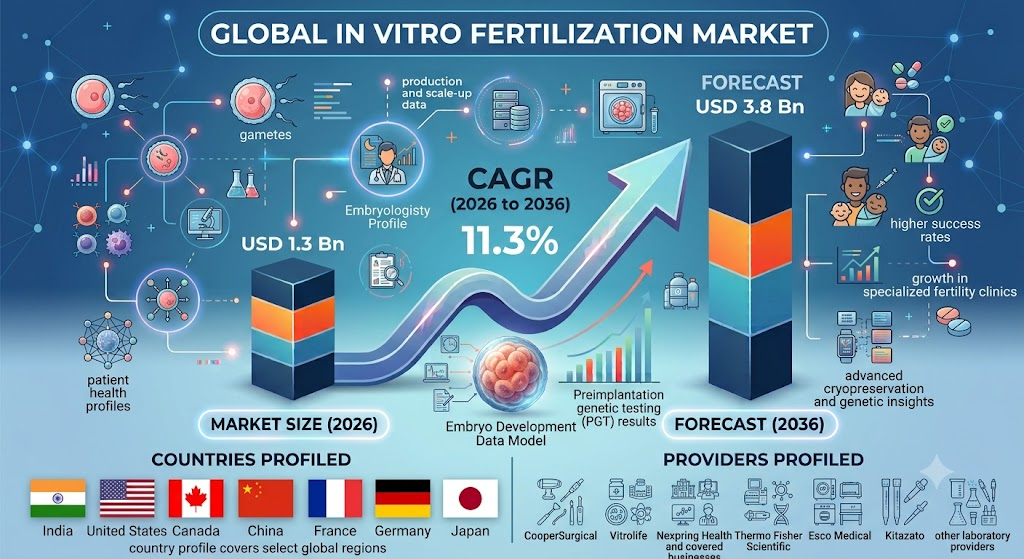
The global in vitro fertilization (IVF) market is projected to grow from USD 1.30 billion in 2026 to USD 3.80 billion by 2036, registering a compound annual growth rate (CAGR) of 11.3%, according to Future Market Insights (FMI). The market was valued at USD 1.17 billion in 2025 and is forecast to add approximately USD 2.5 billion in revenue between 2026 and 2036.
Market expansion reflects demand for fertility care and continued investment in the laboratory equipment, reagents, and consumables required throughout IVF procedures. As fertility clinics expand their capabilities, procurement decisions increasingly connect equipment performance with laboratory workflows, embryo culture, sample identification, cryopreservation, and transfer procedures.
👉 Get Detailed Market Forecasts, Competitive Benchmarking, and Pricing Trends:
https://www.futuremarketinsights.com/reports/sample/rep-gb-14305
Intracytoplasmic sperm injection (ICSI) is projected to account for 55.0% of procedure-segment share in 2026, while fertility clinics are expected to represent 65.0% of end-user demand. These segments highlight the importance of specialist laboratory infrastructure and the materials required to support assisted reproductive procedures.
Key Market Highlights
· Market size (2026): USD 1.30 billion
· Forecast value (2036): USD 3.80 billion
· Forecast CAGR (2026–2036): 11.3%
· Additional revenue opportunity: USD 2.5 billion
· Leading procedure: ICSI, with 55.0% share in 2026
· Leading end user: Fertility clinics, with 65.0% share in 2026
· Fastest-growing profiled country: India, at 11.3% CAGR
· Second-fastest-growing profiled country: United States, at 11.0% CAGR
· Key companies and suppliers: CooperSurgical, Vitrolife, Nexpring Health, Thermo Fisher Scientific, Esco Medical, and Kitazato.
ICSI Leads the Procedure Segment
ICSI is expected to account for 55.0% of the procedure segment in 2026, according to FMI. The procedure involves injecting a single sperm directly into an egg and requires specialized micromanipulation and laboratory-handling equipment.
Its role in IVF creates demand for equipment and supporting materials that enable precise handling of gametes. Clinics must evaluate their product requirements according to the procedures they perform, the capabilities of their embryology teams, and the operating processes used within their laboratories.
ICSI is not appropriate for every fertility patient. Clinical assessment determines whether it is suitable for a particular treatment cycle, and its use should be guided by the relevant clinical circumstances rather than market demand alone.
The broader IVF procedure segment also includes fresh embryo transfer and frozen embryo transfer. These stages require complementary laboratory capabilities, including embryo culture, identification, handling, and storage.
Laboratory Equipment and Consumables Create Recurring Demand
FMI segments the IVF market by equipment, reagents, consumables, and other products. These categories serve different purchasing needs.
Equipment such as incubators, micromanipulation systems, and aspiration devices supports specific laboratory procedures. Reagents and consumables are purchased according to procedure volume, intended application, product availability, and storage requirements.
Cryopreservation adds another layer of laboratory demand. Clinics need appropriate materials and procedures for embryo or oocyte storage, identification, and warming before subsequent treatment. Products must fit the laboratory's established handling protocols and documentation practices.
The resulting procurement environment favors suppliers that can explain product compatibility, provide reliable technical support, and help laboratories plan equipment and recurring material requirements together.
Country-Level Growth Outlook
· India is forecast to grow at 11.3% CAGR. Its projected growth reflects the expanding need for fertility services and the laboratory capabilities required to deliver them. Affordability, specialist availability, and access to suitable facilities will remain important factors in converting demand into treatment activity.
· The United States, at 11.0%, is supported by an established fertility-care sector and ongoing demand for assisted reproductive services. The Centers for Disease Control and Prevention's assisted reproductive technology surveillance program tracks fertility-clinic procedures and outcomes, providing a national framework for monitoring treatment activity.
· Canada is projected to grow at 10.7%, followed by China at 10.5%. Their market outlooks reflect the importance of fertility-service infrastructure, treatment access, and laboratory capacity. Procurement needs will depend on the procedures performed and the resources available at individual facilities.
· France is forecast to grow at 9.7%, while Germany is expected to register 9.2% CAGR. Established healthcare systems and professional reporting frameworks provide context for fertility-service delivery in these markets.
· Japan is projected to grow at 9.1%. Its fertility-care environment includes insurance coverage for specified IVF and ICSI treatment from April 2022, as documented by Japan's Ministry of Health, Labour and Welfare.
These forecasts represent FMI's market projections rather than guaranteed growth in treatment volumes or clinical outcomes.
Access Full Report: https://www.futuremarketinsights.com/reports/in-vitro-fertilization-market
Market Drivers, Restraints, and Opportunities
Drivers: Demand for accessible fertility care
Infertility affects people across regions and income groups, creating demand for prevention, diagnosis, and treatment services. The World Health Organization estimated in 2023 that approximately one in six adults experiences infertility during their lifetime.
IVF laboratories need specialized equipment and supplies to perform the procedures offered by their institutions. Demand for these products is linked to the capacity clinics maintain, the treatment methods they provide, and the resources required to sustain laboratory operations.
In November 2025, the WHO issued its first global guideline on the prevention, diagnosis, and treatment of infertility. The guideline places laboratory-based fertility procedures within a wider care pathway that includes appropriate diagnosis and access to treatment.
Opportunities: Connected laboratory workflows and product integration
Suppliers can create value by helping clinics coordinate equipment, reagents, consumables, identification tools, and technical support across the IVF process.
Electronic witnessing systems can assist with sample identification, while culture and time-lapse systems offer different options for observing embryo development. Clear product documentation and practical implementation support can help clinics assess how these tools fit into their existing laboratory procedures.
Cryopreservation products offer another area for specialized supply. Their adoption depends on compatibility with laboratory protocols, appropriate storage and handling, and the needs of the procedures a clinic performs.
Competitive Landscape and Industry Developments
Competition in the IVF market spans laboratory equipment manufacturers, media and consumables suppliers, cryopreservation specialists, and providers of identification and workflow technologies.
Companies and suppliers identified in FMI's report include:
· CooperSurgical: Fertility-care products, laboratory equipment, and reproductive health technologies.
· Vitrolife: IVF laboratory products, embryo culture systems, and time-lapse imaging technologies.
· Nexpring Health: A reproductive-health platform formed through the combination of reproductive technology and laboratory businesses.
· Thermo Fisher Scientific: Laboratory products and consumables used in assisted reproduction applications.
· Esco Medical: IVF laboratory equipment, including incubator systems.
· Kitazato: Cryopreservation products and materials used in reproductive medicine.
Analyst Perspective
“IVF procurement is a sequence of connected decisions. A laboratory may buy an incubator for long-term use and media or handling materials for repeated procedures. Those purchases need to fit the same operating process, with clear identification and records through each stage. Suppliers can add value by making product compatibility and support understandable, while the clinic evaluates technology through the work it needs to perform.”
— Anurag Sharma, Principal Consultant, Future Market Insights
Frequently Asked Questions
1. How large is the in vitro fertilization market in 2026?
FMI estimates the market at USD 1.30 billion in 2026, following a market value of USD 1.17 billion in 2025.
2. What is the projected market value by 2036?
The market is forecast to reach USD 3.80 billion by 2036, representing an 11.3% CAGR from 2026 to 2036.
3. Which procedure leads the IVF market?
ICSI is projected to account for 55.0% of procedure-segment share in 2026.
4. Which end-user category holds the largest share?
Fertility clinics are expected to represent 65.0% of end-user demand in 2026.
5. Which country has the highest projected growth rate?
India leads FMI's profiled countries with a projected CAGR of 11.3%, followed by the United States at 11.0%.
Related Reports:
· Hyaluronic Acid Products Market - https://www.futuremarketinsights.com/reports/hyaluronic-acid-products-market
· Respiratory Inhaler Devices Market - https://www.futuremarketinsights.com/reports/respiratory-inhaler-devices-market
· Fertility Pregnancy Rapid Test Kits Market - https://www.futuremarketinsights.com/reports/fertility-and-pregnancy-rapid-tests-market
About Future Market Insights (FMI)
Future Market Insights (FMI) is a global market intelligence and consulting firm providing comprehensive market research, competitive intelligence, and strategic business insights across industries. The firm delivers detailed forecasts, technology analysis, and data-driven recommendations that support informed decision-making for manufacturers, investors, distributors, and policymakers worldwide.
For Press & Corporate Inquiries
Rahul Singh
AVP – Marketing and Growth Strategy
Future Market Insights, Inc.
+91 8600020075
For Sales – sales@futuremarketinsights.com
Bub
Do?

الأقسام
إقرأ المزيد
The airport infrastructure integrates digital technologies such as self-service kiosks, biometric gates, and smart signage to modernize passenger experience. Technology adoption continues to speed up airport processes. The Airport Infrastructure Market is witnessing significant expansion as airports worldwide invest in modernization, capacity enhancement, and advanced facilities. The...

As global automakers shift toward zero-emission vehicle fleets, the Automotive Lithium-ion Battery Market serves as the critical enabler for two-wheelers, passenger electric cars, and commercial EVs. Advances in energy density, rapid charging technology, and long battery lifespans are helping overcome traditional electric vehicle range anxiety. Market intelligence from Roots Analysis indicates...
The entire world about us all will be filled up with interesting things and also activities in which illustrate the essential rules regarding research. A couple of intriguing behaviours that will effortlessly seize our own consideration are usually **bouncing** and also **exploding**. แทงหวย Any rubber basketball bouncie on a lawn, popcorn abruptly swallowing, any balloon bursting, or perhaps...
Java logging frameworks play a key role in monitoring application behavior and identifying errors during development and production. Tools like Log4j and SLF4J allow developers to manage logs efficiently and improve system performance. They also help in debugging and maintaining large applications. Gaining hands-on experience through Java Training in Chennai at FITA Academy can help developers...
Square Axial Fan brings comfort to places where fresh air makes all the difference. Imagine a workshop where wood dust floats in the air, or a cozy café kitchen filled with warm aromas—ventilation keeps everything balanced and pleasant. The right airflow doesn’t just cool; it transforms how a space feels, keeping every corner breathable and calm. When the atmosphere feels...