


 Crypto.
 About
About
 sierra
 Conference call
 Terms
Terms
 Privacy
 Sierra market
Automotive Antifreeze Market Size & Forecast, 2032 | UnivDatos
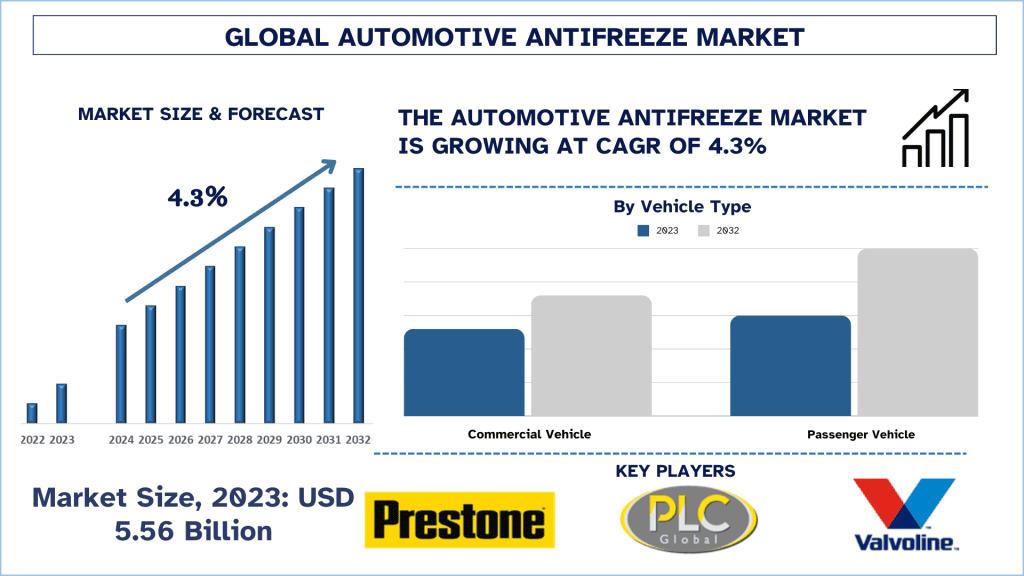
According to UnivDatos, the growth of the automotive anti-freeze market is primarily driven by the need to ensure smooth and efficient engine performance across diverse operating conditions. Automotive anti-freeze plays a critical role in maintaining optimal engine temperatures, protecting components, and improving overall vehicle reliability. As per the “Automotive Anti-Freeze Market” report by UnivDatos, the global market was valued at approximately USD 5.56 billion in 2023 and is projected to grow at a CAGR of around 4.30% from 2024 to 2032, reaching USD billion by 2032.
Modern internal combustion engines operate with increasingly complex designs and precise thermal requirements, making high-quality anti-freeze an essential component of vehicle performance and longevity. Beyond temperature regulation, anti-freeze supports corrosion protection, lubrication, and long-term durability of engine systems.
Composition of Automotive Anti-Freeze
Automotive anti-freeze—commonly referred to as engine coolant—is primarily composed of ethylene glycol or propylene glycol blended with water. Ethylene glycol is the most widely used due to its superior ability to lower freezing points and raise boiling points, though it is toxic and requires careful handling. Propylene glycol serves as a safer alternative in applications where reduced toxicity is preferred.
To enhance functionality, manufacturers incorporate specialized additives, including:
- Corrosion Inhibitors: Protect engine and radiator metals from rust and chemical degradation
- Anti-Foaming Agents: Prevent foam formation that can reduce cooling efficiency
- Dyes: Enable leak detection and differentiation among coolant types
Access sample report (including graphs, charts, and figures): https://univdatos.com/reports/automotive-antifreeze-market?popup=report-enquiry
Types of Automotive Anti-Freeze
Automotive anti-freeze is available in several formulations designed to meet varying engine and environmental requirements:
Inorganic Additive Technology (IAT)
- Traditional green coolant used mainly in older vehicles
- Contains silicates and phosphates
- Replacement interval: ~30,000 miles or 2 years
Organic Acid Technology (OAT)
- Long-life coolant, typically orange or red
- Uses organic acids for corrosion protection
- Common in modern vehicles
- Replacement interval: up to 150,000 miles or 5 years
Hybrid Organic Acid Technology (HOAT)
- Combines IAT and OAT benefits
- Often yellow or orange
- Offers extended protection with silicate enhancement
- Replacement interval: up to 150,000 miles or 5 years
Extended Life Coolants (ELC)
- Designed for heavy-duty and commercial applications
- Provides superior thermal stability and extended service life
Benefits of Automotive Anti-Freeze
While temperature regulation remains the primary function of anti-freeze, it delivers several additional benefits:
- Corrosion Resistance: Protects cooling system components, extending engine lifespan
- Lubrication: Reduces wear on water pumps and seals
- Freeze Protection: Prevents ice crystal formation that can crack engine blocks
- Boil-Over Prevention: Maintains stable engine temperatures under high heat
Maintenance and Replacement Best Practices
Regular inspection and replacement are essential to ensure coolant effectiveness:
Routine Inspection
- Monitor coolant levels and replenish when required
- Check for discoloration or cloudiness, which may indicate contamination
Performance Testing
- Use hydrometers or refractometers to test freeze and boil points
- Apply chemical test strips to assess pH balance and inhibitor strength
Click here to view the Report Description & TOC: https://univdatos.com/reports/automotive-antifreeze-market
System Flushing and Replacement
- Follow manufacturer-recommended service intervals
- Flush the cooling system before refilling with the correct coolant type and mixture
Environmental and Safety Considerations
Ethylene glycol’s toxicity necessitates responsible handling and disposal. Spills should be cleaned immediately to protect pets, wildlife, and groundwater. Although propylene glycol is less toxic, it also requires proper disposal.
Many recycling centers and automotive service providers accept used coolant for recycling. Compliance with regional environmental regulations is essential to minimize ecological impact and ensure sustainable automotive practices.
Conclusion
Automotive anti-freeze is a critical fluid that supports engine efficiency, durability, and safety across a wide range of operating conditions. A clear understanding of coolant composition, types, and maintenance practices enables vehicle owners and fleet operators to optimize performance while reducing long-term repair costs. As automotive technologies continue to evolve, manufacturers are increasingly developing advanced and environmentally friendly anti-freeze formulations, ensuring improved protection and sustainability for next-generation engines.
Contact Us:
UnivDatos
Contact Number - +1 978 733 0253
Email - contact@univdatos.com
Website - www.univdatos.com
Linkedin- https://www.linkedin.com/company/univ-datos-market-insight/mycompany/
Bub
Do?

Categories
Read More
Building a team around Castorice in Honkai: Star Rail presents some unique challenges due to her specialized kit. She benefits most from being paired with characters that have high health pools, as her abilities synergize poorly with shields which offer little benefit to her playstyle. Despite these constraints, players at any level can assemble a functional Castorice team by selecting...

Windscribe moves beyond VPNs by forming a strategic alliance with specialized privacy tools. This initiative offers a compartmentalized approach to digital security. Pro subscribers gain access to exclusive discounts across a curated suite of independent services. The partnership includes encrypted note-taking, anonymous email aliasing, and private photo storage. Decentralization is key; using...
Umbrella Universe Expands Although season 4 closed one chapter of The Umbrella Academy on screen, the Hargreeves saga continues in Gerard Way and Gabriel Bá’s Dark Horse graphic novels. Way, the comics’ creator and lead singer of My Chemical Romance, and Bá, the series’ artist, were in Hollywood for the Aug. 5 premiere at the Egyptian Theatre to mark the...
Greetings, trainers! Here is the ultimate Pokédex for Pokémon Legends Z-A, encompassing every Pokémon confirmed to date. This compilation includes detailed information on each species' type, ability, and base stats. The data has been meticulously extracted from the game files and cross-verified by multiple community sources to ensure its reliability. For those interested in...
In a recent interview, Matthew Lillard revealed his limited role in the newly released "Five Nights at Freddy's 2," where he reprises his character William Afton. Despite being the main antagonist in the original film, where his character met a gruesome fate inside the Spring Bonnie suit, Lillard confirmed fans shouldn't expect much screen time from him in the sequel. "Unfortunately for me, I...