


 Crypto.
 Sobre
Sobre
 Passport
 Conference call
 send money
 Termos
 Privacidade
 Sierra market
Offshore Company Requirements in the UAE: Documents, Eligibility and Setup Process
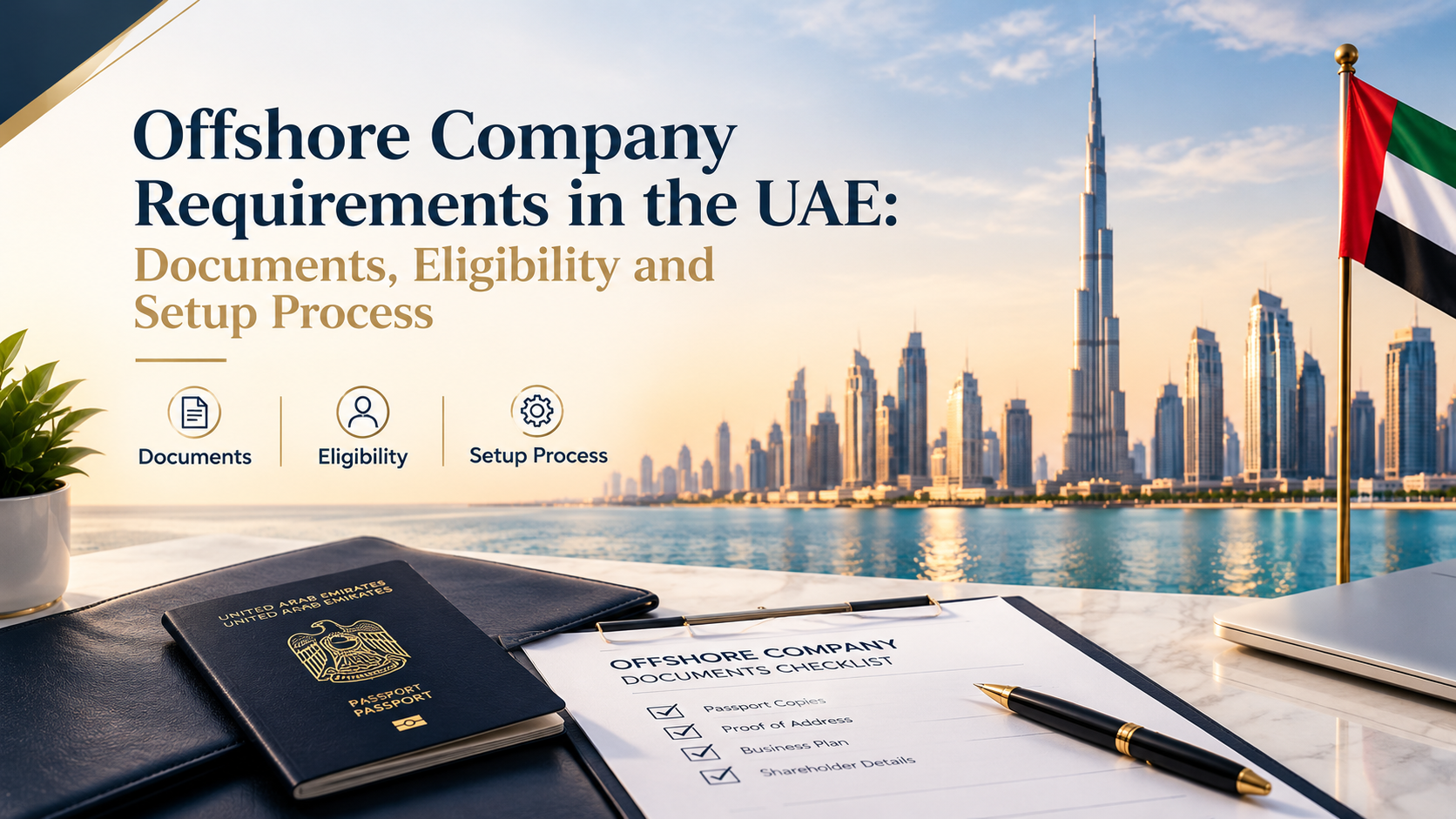
Setting up an offshore company in the UAE can provide an appropriate corporate structure for international business activities, holding arrangements, investment structures, and certain asset ownership purposes. However, choosing an offshore structure requires careful attention to eligibility rules, documentation, registered agent requirements, compliance procedures, and the regulations of the selected jurisdiction.
Understanding the offshore company requirements UAE investors must satisfy before starting the registration process can make the setup more organized and reduce delays caused by incomplete or incorrectly prepared documents.
UAE offshore structures are not identical across all jurisdictions. Requirements can differ depending on whether an investor chooses JAFZA, RAK ICC, or another permitted offshore jurisdiction. Therefore, entrepreneurs should review the specific rules that apply to their chosen structure before submitting an application.
What Is an Offshore Company in the UAE?
An offshore company is a corporate structure generally designed for activities connected with international business, investment holding, asset ownership, or other permitted purposes rather than operating as a conventional UAE mainland business.
For example, JAFZA states that offshore companies may be used for international trade, holding companies, real estate ownership, intellectual property-related purposes, and international consulting activities, subject to applicable rules.
An offshore company should not automatically be considered equivalent to a UAE mainland or free zone operating company. Its permitted activities, licensing framework, banking options, tax position, and ability to conduct business in the UAE can differ.
Who Can Set Up an Offshore Company in the UAE?
One of the first offshore company requirements UAE investors should consider is eligibility.
Depending on the jurisdiction, offshore companies may accommodate:
- Individual shareholders
- Corporate shareholders
- Multiple shareholders
- International investors
- Holding structures
- Investment companies
- Businesses involved in permitted international activities
- Companies seeking a UAE-based corporate structure for specific investment or ownership purposes
JAFZA, for example, states that an offshore company can have at least one shareholder, with no stated maximum number of shareholders. Shareholders may be individuals, non-individuals, or a combination of both.
However, eligibility does not mean every business activity is automatically permitted. Investors need to confirm that their intended activities and corporate objectives fit the rules of the selected offshore jurisdiction.
Key Offshore Company Requirements UAE Investors Should Know
The exact requirements vary according to the jurisdiction and applicant profile, but several areas commonly need attention.
1. Valid Identification Documents
Individual applicants and relevant company officers generally need valid identification documents.
For JAFZA offshore registration, the official documentation includes passport copies for the board members, directors and secretary, while individual applicants must provide a passport copy and specimen signature.
Investors should ensure that:
- Passport copies are clear and valid
- Names match across submitted documents
- Signatures are provided where required
- Supporting identification documents are consistent
- Any requested certification or attestation is completed correctly
2. Memorandum and Articles of Association
The Memorandum and Articles of Association are important corporate documents that establish the company's structure, governance and operating framework.
JAFZA lists the Memorandum and Articles of Association among the legal documents required for offshore company registration.
The documents should be prepared according to the requirements and templates applicable to the selected jurisdiction.
3. Registered Agent
A registered agent can be an important part of the offshore incorporation process.
For JAFZA offshore companies, registration must be processed through a JAFZA Registered Agent. The agent handles communication and document submission with the relevant offshore section.
Before proceeding, investors should therefore determine:
- Which registered agents are authorized
- What services the agent provides
- Which documents the agent requires
- Whether the agent assists with KYC and compliance
- What professional fees apply
4. Know Your Customer and Beneficial Ownership Information
KYC and beneficial ownership information are important parts of modern company formation and compliance procedures.
Applicants may need to provide information about:
- Shareholders
- Directors
- Authorized representatives
- Ultimate beneficial owners
- Source and nature of business activities
- Corporate ownership structures
The purpose is to allow the relevant authority or registered agent to understand who owns and controls the company and the nature of the proposed business relationship.
5. Proof of Address
Depending on the jurisdiction and applicant profile, proof of residential or registered address may be required.
For example, the RAK ICC incorporation checklist includes documents such as a current utility bill, tax bill, tenancy agreement, residency certificate or bank statement showing the individual's permanent residential address for individual shareholders and ultimate beneficial owners.
Applicants should therefore keep recent address documentation available before beginning the incorporation process.
6. Corporate Documents for Company Shareholders
When another company will hold shares in the offshore company, additional corporate documentation is normally required.
JAFZA's offshore requirements for non-individual applicants include documents such as:
- Certificate of Registration or Formation
- Certificate of Good Standing
- Incumbency Certificate
- Memorandum and Articles of Association
- Board Resolution
- Power of Attorney
- Passport copy of the Power of Attorney holder
- Specimen signature
JAFZA also specifies notarization and UAE Embassy attestation for several of these documents.
The precise attestation process can depend on the country where the shareholder company was established.
Offshore Company Documents Checklist
A basic documentation checklist can help investors prepare before contacting a registered agent.
| Applicant / Requirement | Common Documents |
|---|---|
| Individual shareholder | Passport copy, application documents, specimen signature |
| Ultimate beneficial owner | Passport and identification information |
| Address verification | Utility bill, bank statement, tenancy agreement or equivalent |
| Company shareholder | Certificate of incorporation/registration |
| Corporate shareholder | Certificate of Good Standing |
| Corporate structure | Incumbency or register extract |
| Company governance | Memorandum and Articles of Association |
| Corporate authorization | Board/shareholder resolution |
| Representative | Power of Attorney where applicable |
| Agent relationship | Registered agent appointment letter |
| Compliance | KYC and beneficial ownership information |
This is a general checklist rather than a universal list. The final requirements depend on the offshore jurisdiction, ownership structure and applicant circumstances.
Additional Documents for Corporate Applicants
Corporate shareholders usually face a more detailed document review than individual shareholders.
The reason is straightforward: the authority needs to establish the legal existence of the shareholder company and identify the individuals who ultimately own or control it.
For example, RAK ICC's published incorporation checklist includes corporate registration documents, Memorandum and Articles of Association, current incumbency or register extracts, a Certificate of Good Standing, an authorized signatory's passport, shareholder and ultimate beneficial owner information, and a corporate resolution approving incorporation.
Where documents originate outside the UAE, notarization, legalization or attestation may be required depending on the jurisdiction and document type.
Offshore Company Setup Process in the UAE
Once the eligibility and documentation requirements have been reviewed, the setup process can generally be organized into several stages.
Step 1: Define the Business Purpose
Start by identifying why the offshore company is required.
Potential objectives may include:
- International holding structures
- Investment holding
- Ownership of permitted assets
- International trading arrangements
- Intellectual property ownership
- Corporate structuring
The intended purpose should be compatible with the rules of the selected jurisdiction.
Step 2: Select the Offshore Jurisdiction
The UAE has more than one offshore structure, and the requirements are not identical.
Investors may evaluate jurisdictions such as JAFZA and RAK ICC based on:
- Permitted activities
- Ownership structure
- Asset-holding requirements
- Corporate governance
- Registered agent requirements
- Documentation
- Ongoing compliance
- Banking considerations
- Costs and renewal obligations
The correct choice depends on the company's actual objectives rather than simply selecting the jurisdiction with the lowest initial cost.
Step 3: Choose a Registered Agent
Where the chosen jurisdiction requires one, appoint an authorized registered agent.
For JAFZA offshore registration, selecting a registered agent is specifically part of the setup process, and the agent is responsible for administrative dealings with JAFZA.
Step 4: Prepare the Required Documents
Collect the relevant personal, corporate and compliance documents.
At this stage, check:
- Passport validity
- Spelling of names
- Address information
- Corporate ownership details
- Board resolutions
- Power of Attorney documents
- Memorandum and Articles of Association
- Certification and attestation requirements
Preparing the documents correctly at the beginning can reduce requests for clarification later.
Step 5: Complete KYC and Beneficial Ownership Checks
The registered agent and relevant authority may review the ownership structure, business purpose and supporting information.
This can involve identifying the ultimate beneficial owners and verifying the information supplied in the application.
Step 6: Submit the Application
After the documentation has been completed, the application can be submitted through the relevant registration process.
For JAFZA, the registered agent submits the required offshore documentation through the designated process.
Step 7: Respond to Additional Information Requests
Authorities may request additional documents or clarification.
JAFZA specifically notes that the Registrar may request additional documentation where necessary.
Applicants should therefore avoid assuming that the initial checklist represents an absolute limit on documentation.
Step 8: Complete Registration
Once the application has been reviewed and accepted, the company can receive its incorporation or registration documents.
For JAFZA, the published processing time for a new offshore company is 5 to 7 working days, subject to the application and documentation requirements.
How Long Does Offshore Company Formation Take?
The timeline depends on the jurisdiction, ownership structure, document readiness and whether additional information is requested.
For a straightforward JAFZA offshore application, the published processing time is 5 to 7 working days.
However, investors should allow additional time for:
- Preparing documents
- Notarization
- Embassy or government attestation
- KYC review
- Corporate shareholder verification
- Additional document requests
- Registered agent processing
Therefore, having complete documentation before submission can be important for keeping the process on schedule.
Offshore Company Requirements for Individual vs Corporate Shareholders
The documentation burden can differ significantly depending on who owns the company.
| Requirement | Individual Shareholder | Corporate Shareholder |
|---|---|---|
| Passport | Usually required | Required for relevant representatives |
| Proof of address | May be required | May be required for relevant individuals |
| CV / founder details | May be required | Usually corporate documents are more important |
| Certificate of incorporation | Not applicable | Required |
| Certificate of Good Standing | Not applicable | May be required |
| Incumbency information | Not applicable | May be required |
| Board resolution | Not usually applicable | Commonly required |
| Power of Attorney | Where applicable | Commonly required where a representative is appointed |
| UBO information | Required | Required |
The final checklist should always be confirmed with the selected jurisdiction or its authorized registered agent.
Common Mistakes When Preparing Offshore Company Documents
Even when the offshore structure itself is appropriate, documentation problems can slow down incorporation.
Submitting Expired Documents
Expired passports, outdated certificates or old corporate records may result in additional requests.
Ignoring Attestation Requirements
Some corporate documents may need notarization and attestation before they can be accepted.
Providing Inconsistent Information
Differences in names, addresses, ownership details or company information across documents can create unnecessary verification issues.
Failing to Identify the Ultimate Beneficial Owner
Ownership structures should be transparent and properly documented. UBO information is an important part of modern corporate compliance.
Choosing a Structure Without Checking the Business Purpose
An offshore company is not automatically suitable for every business activity. Investors should first establish whether the intended activity is permitted under the chosen jurisdiction.
Treating Offshore and Free Zone Companies as the Same
Although both structures may be associated with the UAE's international business environment, their purposes, operating requirements and regulatory frameworks can differ substantially.
Offshore Company Requirements and Banking
Company formation and corporate banking are separate considerations.
Registering an offshore company does not automatically guarantee approval for a corporate bank account. Financial institutions may conduct their own KYC, risk assessment and source-of-funds checks.
Applicants may therefore need additional information such as:
- Company incorporation documents
- Business profile
- Ownership structure
- Identification documents
- Expected transaction activity
- Source of funds
- Contracts or invoices
- Evidence of business relationships
- Financial information
Businesses should evaluate banking requirements early rather than waiting until after incorporation.
Offshore Company Compliance After Formation
Meeting the initial offshore company requirements UAE authorities request is only the beginning of the corporate lifecycle.
Depending on the jurisdiction and circumstances, an offshore company may need to maintain:
- Updated corporate records
- Beneficial ownership information
- Registered agent arrangements
- Annual renewal requirements
- Accounting records
- Supporting transaction documentation
- Corporate resolutions
- Regulatory filings
- Applicable tax and compliance records
For example, RAK ICC states that annual renewal involves an annual return and updated documents where KYC documents have expired. It also requires notification of certain changes to ultimate beneficial ownership.
Frequently Asked Questions
What are the basic offshore company requirements in the UAE?
Common requirements include a valid passport, application documents, Memorandum and Articles of Association, ownership information, KYC documentation, beneficial ownership information and, where applicable, a registered agent appointment. Additional documents may apply depending on whether the shareholder is an individual or company.
Can a foreigner set up an offshore company in the UAE?
Foreign investors can establish offshore structures where they meet the eligibility and documentation requirements of the selected jurisdiction. The exact rules should be confirmed before applying.
Do offshore companies need a registered agent?
The requirement depends on the jurisdiction. JAFZA requires offshore company registration to be processed through a JAFZA Registered Agent.
What documents are required for an offshore company in Dubai?
For JAFZA, the published requirements include the offshore application, Memorandum and Articles of Association, registered agent appointment letter, board member passport copies, and additional documents depending on whether the applicant is an individual or non-individual.
How long does offshore company registration take?
The timeline varies by jurisdiction and application. JAFZA currently publishes a processing time of 5 to 7 working days for a new offshore company, provided the application meets its requirements.
Can an offshore company have a corporate shareholder?
Yes. JAFZA's offshore framework permits non-individual shareholders, while additional corporate documents are required for verification.
Is proof of address required?
Proof of address may be required depending on the jurisdiction and applicant profile. RAK ICC, for example, includes current proof of permanent residential address among its requirements for individual shareholders and ultimate beneficial owners.
Does offshore company registration automatically provide a UAE bank account?
No. Corporate bank account approval is a separate process and depends on the bank's KYC, risk assessment and supporting documentation requirements.
Final Checklist for Offshore Company Formation
Before submitting an offshore company application, investors should review the following:
-
Confirm the purpose of the offshore company
-
Select an appropriate UAE offshore jurisdiction
-
Confirm eligibility
-
Identify all shareholders
-
Identify ultimate beneficial owners
-
Select a registered agent where required
-
Prepare valid passport copies
-
Prepare proof of address where required
-
Prepare the Memorandum and Articles of Association
-
Obtain corporate certificates for company shareholders
-
Prepare board resolutions where applicable
-
Arrange Power of Attorney documents where required
-
Complete KYC information
-
Check notarization and attestation requirements
-
Submit the application
-
Respond to additional document requests
-
Maintain ongoing compliance after incorporation
Conclusion
Understanding the offshore company requirements UAE investors need to satisfy is an important first step toward establishing an appropriate corporate structure. The process generally involves determining the business purpose, selecting a suitable jurisdiction, confirming eligibility, preparing personal or corporate documentation, completing KYC procedures, appointing a registered agent where required, and submitting the application.
Requirements can vary considerably between offshore jurisdictions and between individual and corporate applicants. Investors should therefore avoid relying on a generic checklist alone and confirm the current requirements applicable to their specific structure.
Professional guidance from Dubai Business and Tax Advisors can help investors evaluate the available UAE offshore structures, organize incorporation documentation, understand compliance requirements, and approach the setup process with a clearer understanding of the relevant obligations.
A well-prepared application can make offshore company formation more structured while helping investors address documentation and compliance requirements from the beginning.
Bub
Do?

Categorias
Leia Mais
Aventures et Réussites Dans les profondeurs de Nod-Krai, le Curatorium des Secrets abrite une aventure nocturne. Le Chant de l'Astre de la Nuit, dans son acte septième, dévoile trois réalisations mystérieuses. Ces succès, voilés aux regards pressés, attendent le chercheur patient. Le premier murmure le nom d'un « Voyageur, par une...

A significant cybersecurity incident has compromised the Pajemploi platform, a French social security system designed for parents and professional childcare workers. The breach potentially affects approximately 1.2 million registered caregivers who provide services to private households. Pajemploi operates under Urssaf, France's primary organization responsible for managing social security...
Respirator Collection Guide Collecting expired respirators is essential for advancing through the second stage of the trophy showcase, titled "Soaring Menaces." To meet this requirement, gather three expired respirators, which can sometimes be found in medical loot pools. However, the most efficient and safest approach is to farm the testing annex area within the dam battlegrounds map....
The Nerve Center of German Cybersecurity Defense The Germany Security Operations Center industry represents the critical nerve center of the nation's cybersecurity defense, providing the essential human and technological capabilities to protect German businesses and public institutions from a relentless barrage of cyber threats. A Security Operations Center (SOC) is a centralized...

In Wuthering Waves, Mornye stands out as a versatile fusion character, primarily serving as a support unit. Her abilities focus on healing allies and enhancing team performance, with her effectiveness scaling according to her defense percentage. To optimize her potential, players should consider the most effective weaponry and echo setups. This guide will detail the top weapon choices and...
